BLAST WHEEL BLADES · 56–60 HRC
The blade is the heart of the blast wheel.
Your motor makes the energy. The blade is the only part that carries it all the way to the abrasive. Where the shot leaves the blade tip is where your blast pattern lands.
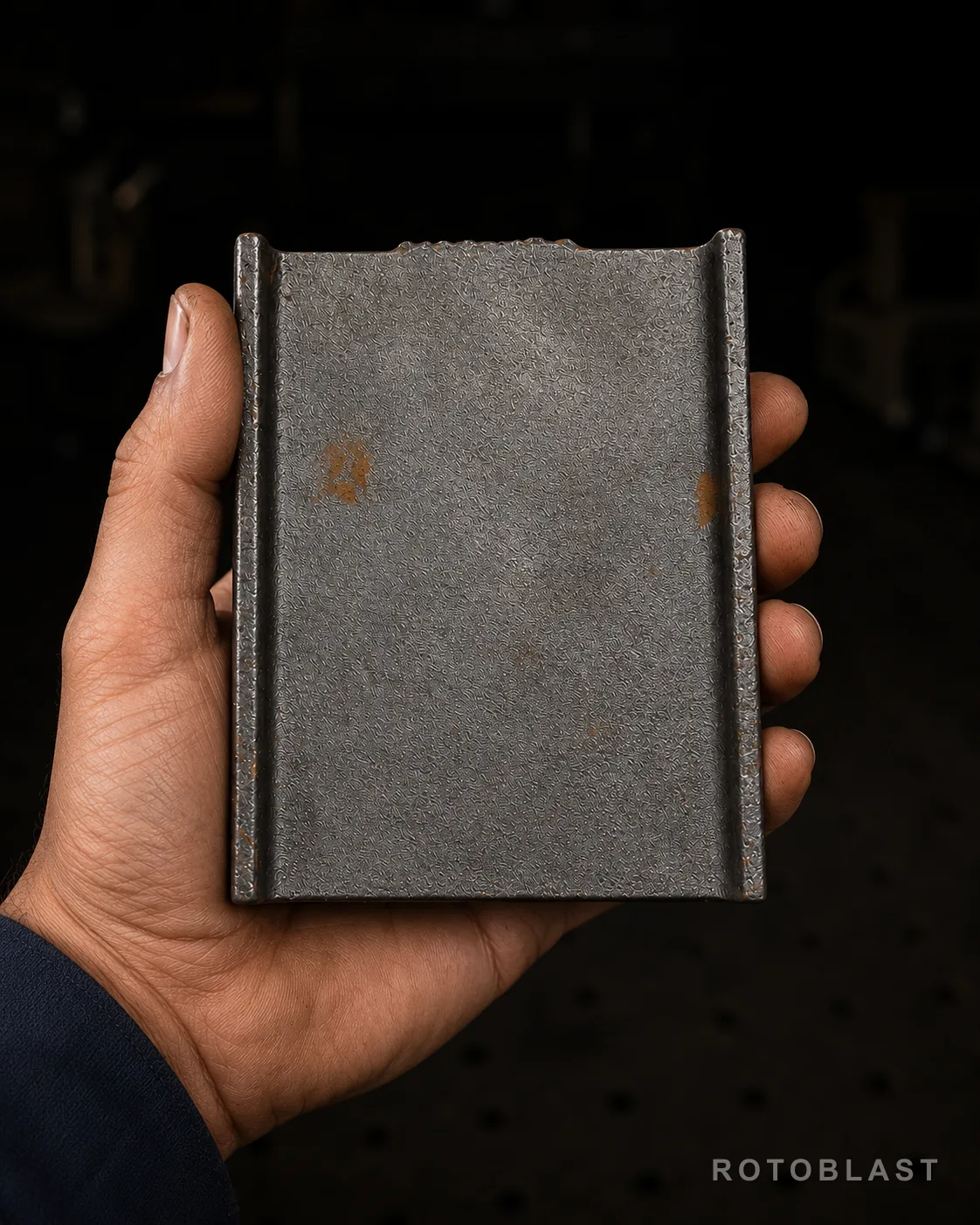
- Working hardness range
- 56–60HRC
- Supplied per wheel, not per piece
- 1SET
- Made at Faridabad, supplied India & UAE
- IN· AE
Throwing blades, vanes, impeller blades, turbine blades. Catalogues list them as shot blasting machine blades or shot blast blades. Different plants, different words, same wear part.
STATION 01 · ENERGY TRANSFER
A blast wheel is an energy machine.
The motor spins the wheel. The wheel spins the blades. Every other part of the machine only moves abrasive around. The blade is the one part that takes the motor's energy and puts it into the shot.
01
Abrasive drops in
Shot enters the middle of the wheel through the feed spout. At this point it is barely moving.
02
The impeller picks it up
The impeller turns at the same speed as the blades. Centrifugal force pushes the shot outward, against the inside of the control cage.
03
The cage opens once per turn
The control cage has one opening. Shot can only leave the centre through it. That opening is what times the release.
04
The blade takes over
From the cage opening the shot lands on a blade and starts sliding outward. Everything after this point is the blade's job.
Four links, and the blade is the last one
Motor to wheel. Wheel to blade. Blade to shot. Shot to part. The blade is the only link that touches the abrasive at full speed. That is also why it goes first: of all the blast wheel wear parts, blades have the highest wear rate, and they are the one item you replace as a routine.
STATION 02 · THE RIDE ALONG THE BLADE
The shot is not thrown. It is accelerated.
Shot lands near the root of the blade and slides out to the tip. It is picking up speed the whole way. It leaves the machine at the speed it reached at the tip — not before. Some catalogues call them abrasive throwing blades, but nothing is thrown. The shot is let go at speed.
At the root · Slow
The shot has just come through the cage opening. It is turning with the wheel but it has hardly moved outward yet.
01
Speed comes from the wheel, not the blade
Throwing speed is set mainly by how fast the wheel turns and how big it is. Wheel makers usually rate this somewhere around 65 to 85 metres per second. A blade does not add speed of its own — it delivers the speed the wheel has.
02
The blade sets the timing
Shot leaves the tips roughly opposite the cage opening, about 180 degrees around the wheel. Blade length, blade wear and abrasive size all move that release point.
03
Every blade must do the same thing
All the blades on one wheel are fed the same. If one is a different length or a different shape, it releases at a different point, and that share of the stream goes somewhere else.
STATION 03 · WHERE IT LANDS
The blast pattern is the blade's signature.
Shot leaves the tips as a fan. That fan is your blast pattern. Where it sits on the part decides which areas get cleaned properly and which come out short.
01
It is a fan, not a jet
The shot leaves a moving tip, not a fixed nozzle. Each particle leaves at a slightly different instant, so the stream opens out into a fan.
02
The cage sets its length
A narrower cage opening angle gives a tighter, more concentrated pattern. A wider one spreads it. This is chosen for the machine and the work, and it is set at the cage, not the blade.
03
The blades set its aim
Rotating the cage moves the fan on purpose. Blade condition moves it too — and nobody rotated anything.
A pattern off the part costs you twice
Abrasive that misses the work does not disappear. It lands on the cabinet wall, the liners or the conveyor instead. So you pay once in cleaning you did not get, and again in wear you did not need.
STATION 04 · THE SAME JOURNEY, WORN
A worn blade lets go too late.
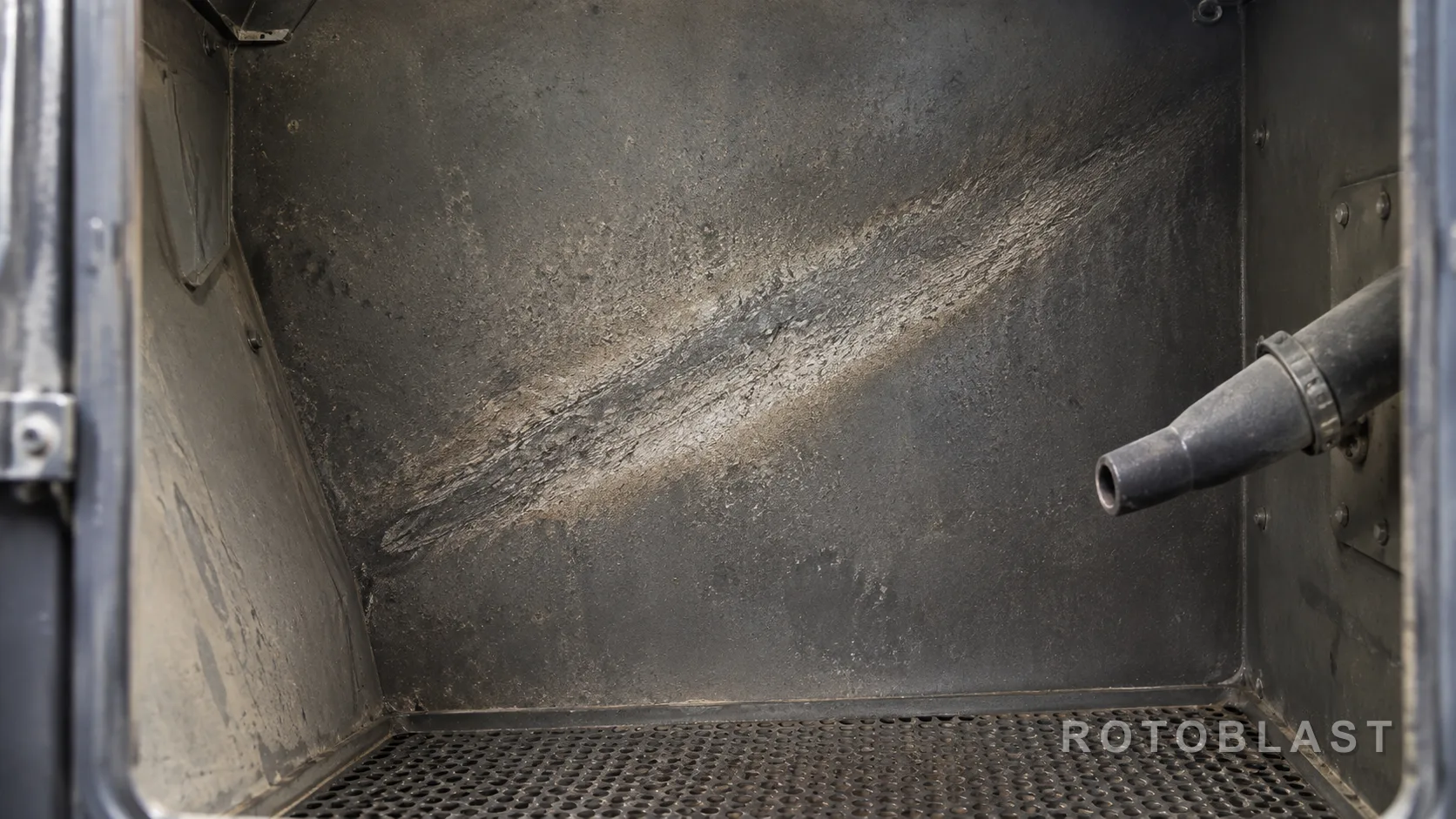
This is the part most plants miss. As the working face wears back, the shot rides the blade for longer before it leaves. A later release means the fan comes out further around the wheel. Your pattern moves off the target, and nobody touched a setting.
01
Release comes later
The shot stays on the face past the point it used to leave.
02
The fan moves round
It lands further along the part, or off it.
03
Coverage drops
Some areas get blasted twice. Some get missed.
04
Cycle time goes up
Operators add running time until the parts look right again.
05
Cost per part goes up
More abrasive, more power and more liner wear for the same finished part.
What this looks like from the shop floor
Cleaning has gone patchy
Same parts, same cycle, but one area comes out bright and another still carries scale.
Cycle time crept up
Nobody decided to run longer. Time was added a bit at a time until the parts passed.
The wheel sounds different
A rough or uneven note usually means the blades are no longer alike.
Wear in a new place
Liners going in a spot that used to be fine means the stream is landing somewhere new.
Abrasive use is up
You are throwing the same amount of shot and cleaning less of the part with it.
None of this proves it is the blades
A worn control cage shifts the pattern too, and a worn impeller feeds the blades unevenly. That is why these three blast wheel components are inspected together. Fitting new blades behind a worn cage fixes the symptom for a week.
STATION 05 · BALANCE
The blades are the moving weight.
A blast wheel is a balanced rotating assembly, and the blades are the part of that assembly you take off and put back. It stays balanced only while they all weigh close to the same. This is why blades are counted and sold per wheel.
01
One heavy side
Fit one new blade among worn ones and that side of the wheel is now heavier. The wheel is out of balance from the first switch-on.
02
The bearings carry it
The out-of-balance load goes into the shaft and bearings on every single rotation. You may never hear it over the machine.
03
The stream goes unsteady
A vibrating wheel does not release cleanly, so the pattern moves slightly with every turn and the finish stops being repeatable.
Change the set, keep the set
Replace every blade on a wheel together. And keep the set you took off. An evenly worn used set is a far better emergency spare than one new blade — it will at least run balanced until the replacement arrives.
STATION 06 · HOW WE MAKE THEM
Same profile, same weight, every blade in the box.
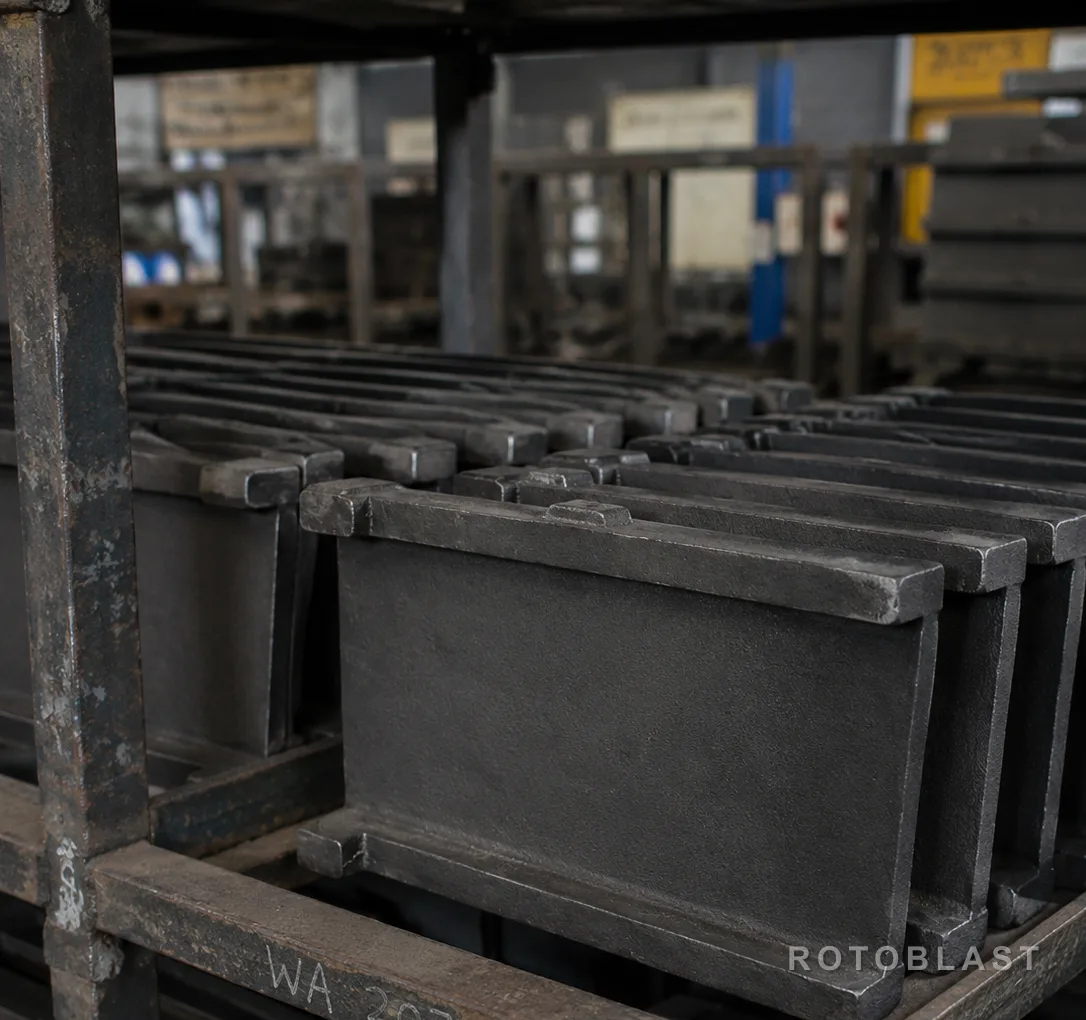
Because the blades share one job, they have to be the same part. Ours are made to a fixed profile and a fixed hardness range, so a set behaves as one wheel rather than as eight or ten separate pieces.
56–60HRC
Working hardness range
HRC is the scale used to measure how hard metal is.
Blast wheel blade hardness is a trade-off, not a score. This range is chosen to resist abrasive wear while keeping enough toughness for the constant knocking of the feed. A blade that is only hard is easy to chip. A blade that is only tough wears its face away. The range is where a production blade has to sit.
01
Dimensional accuracy
Length and profile are held to the same figures across a production run, so blades interchange within a set and release at the same point.
02
Matched set supply
Blades ship counted to your wheel, not by the piece. The count is part of the order because balance is part of the product.
03
Made to your fixing
The end that locks into the wheel is not common between makes. We make to the fixing your wheel actually uses.
04
Engineered and made in our own works
We are a blast wheel blade manufacturer, not a reseller. Blades are made at Rotoblast's works in Faridabad, India, and supplied to foundries, fabricators and machine owners across India and the UAE.
STATION 07 · INSPECTION
Two minutes a day is the whole maintenance plan.
There is no honest hour figure for blade life. It depends on your abrasive, your wheel speed, how clean your separator keeps the media, and how many hours you run. So inspect on a routine and change on condition. Do not change on a calendar.
When
What you check
Why it matters
Every day
Look along the working face of each blade
You are looking for one blade that is clearly further gone than the rest. That is the set telling you it is due.
Every week
Check the control cage opening and the impeller
A worn cage moves the pattern on its own. Replacing blades alone will not put it back.
Every week
Check the separator is doing its job
Sand and fines in the abrasive cut blades faster than clean shot does. Blade life is often a separator problem.
At every change
Clean the blade seats before fitting
Grit packed in a seat holds a blade proud. That is the most common reason a wheel vibrates straight after a blade change.
Measure against a blade, not against a number
Keep one new blade out of the set as a reference and hang it by the machine. Held next to a running blade, the difference in the working face is obvious in a second, and it does not need a gauge or a table.
Change the set when any one of these is true
- One blade is clearly ahead of the others in wear.
- The pattern has moved and the control cage checks out good.
- Any blade is cracked, chipped, or loose in its seat.
IDENTIFY YOUR BLADE
You can identify a blade with a tape measure.
Blades are not common between makes, and most machines on the floor have lost their paperwork. You do not need it. Four things taken at the wheel are enough for us to match the blade.
01
Length, tip to fixing end
Measure the whole blade, not just the working face. This is the figure that changes most between wheels.
02
Width across the face, at the root
Worn blades lose width at the tip, so the root end is the honest measurement.
03
How it locks into the wheel
Look at the end that sits in the wheel. Some slide into a slot and are held by the cage; some sit on a shoulder. Photograph it.
04
How many are on the wheel
Count them. Blades are supplied as a set per wheel, so the count is part of the order, not an afterthought.
If the blade is too worn to measure
Send photographs of both faces with a tape measure lying in shot, and tell us the machine make if you know it. We can work from that. A sample blade in the post is better still.
We supply industrial blast wheel blades for tumblast, hanger, table type, roller conveyor and wire mesh machines. We make the blast wheel spare parts that sit around them too: control cages, impellers, liners and housings. As a shot blasting blade manufacturer, we can work from a sample when a wheel is an import and the blade is not a standard size.
REPLACEMENT
Changing a set, in order.
Replacement blast wheel blades go in as a full set, so plan an hour rather than a five-minute swap. None of this is difficult. It goes wrong when steps are skipped, and it usually goes wrong in a way that only shows up as vibration or a bad pattern a week later.
01
Isolate and lock off
Power locked out, and let the wheel come to a complete stop before the door opens. A blast wheel coasts for a long time after the motor is off.
02
Mark the direction of rotation
Mark it on the housing before anything comes out. Blades are handed on many wheels, and a reversed set throws nowhere useful.
03
Take the whole set out
All of them, including the ones that still look serviceable.
04
Clean every seat
Packed grit in a seat is what puts a freshly bladed wheel out of balance.
05
Look at what sits behind them
With the blades out you can see the cage opening and the impeller properly. This is the only free look you get all year — take it.
06
Fit the set the same way round
Same orientation on every blade, and each one fully home before it is locked.
07
Turn it by hand, then run it empty
It should turn freely and evenly. Run the wheel with no abrasive for a minute and listen. A steady note means the set is even.
08 · Before production
Then check your blast pattern before you run production
This is the step that gets missed. A worn set was releasing late, so anyone who tuned the pattern in the meantime tuned it around worn blades. A new set releases at the designed point again — which means the pattern you just restored is now in the wrong place until you set it back.
STRAIGHT ANSWERS
What engineers ask us before they order.
SUPPLY
Tell us the wheel. We will match the set.
Four measurements and one photograph are enough to confirm the blade and quote a full set for your wheel. If you would rather not measure, post us a worn blade and we will work from it.
Lead time
Depends on blade size, set count and production scheduling. A confirmed date is given at order confirmation.
Related
- Blast wheel assembliesThe cage, impeller and housing that decide the rest of the pattern.
- Control cageCheck this before you blame the blades. It aims the whole stream.
- Heavy Duty BladesFor machines running heavy castings around the clock.
- Wheel hubWhat the blades bolt to. Worn seats knock a fresh set out of balance.
- Steel shotAbrasive size and cleanliness set how fast blades wear.
- Shot blasting spare partsLiners, cages, impellers and the rest of the shot blast wheel parts.
Rotoblast manufactures this part alongside the rest of the wear items a shot blasting machine consumes. Browse the full spare parts range
Request a quote
Tell us your application, part size and throughput — we'll respond with a specification and price.
Faridabad, Haryana, India
Mon–Sat, 9:30 AM – 6:30 PM IST