
STEEL SHOT · CAST HIGH-CARBON ABRASIVE
The only part of the machine you buy again every month.
Everything else in a blasting machine wears out slowly. The abrasive is consumed continuously — which makes it the component that quietly sets your cleaning rate, your finish and your cost per tonne.
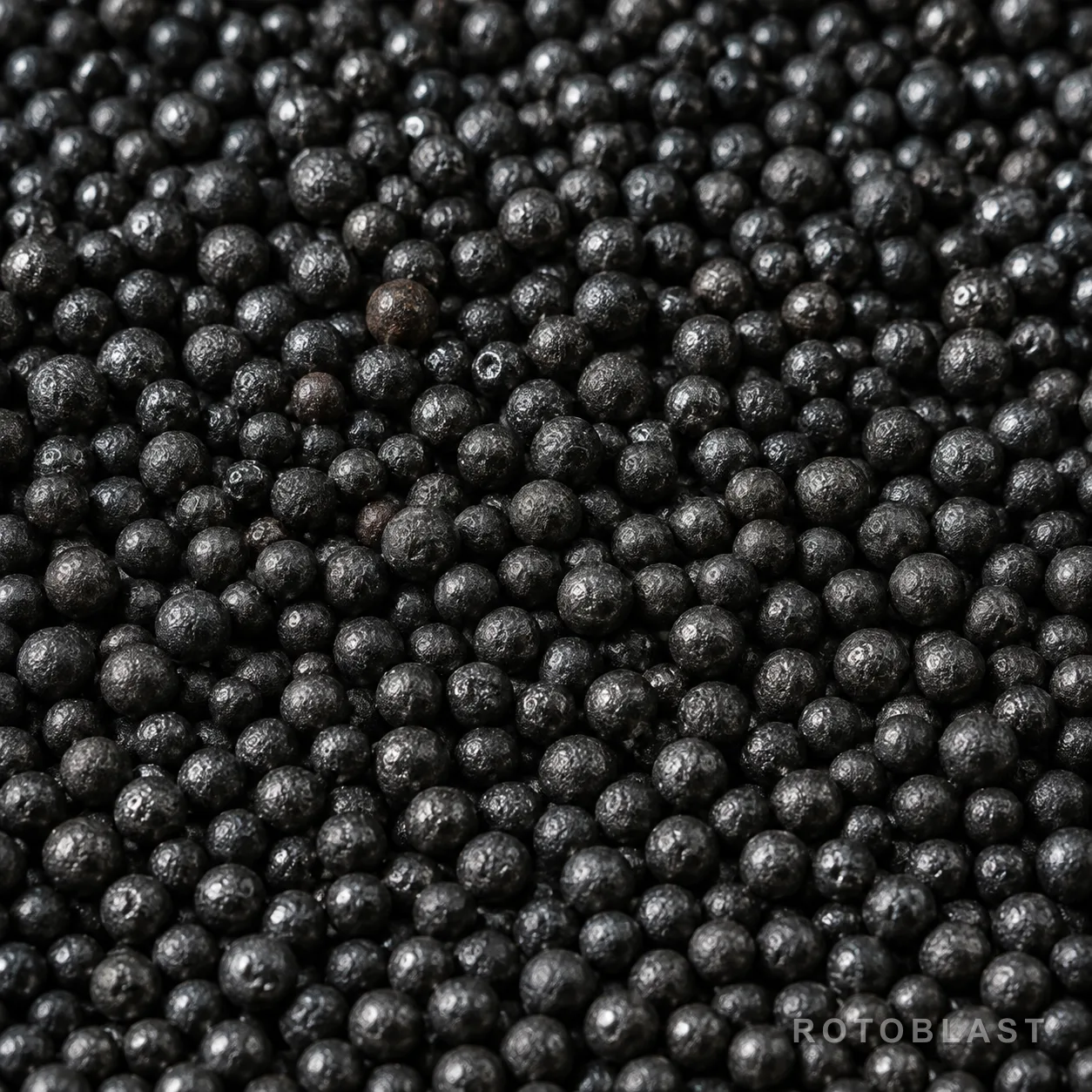
WHAT YOUR PURCHASE ORDER ACTUALLY SAYS
“S330 to SAE J444” fixes the size. It fixes nothing else.
J444 is a sieve specification. It defines how the sizes are distributed in the batch and stops there — which is why two deliveries can both be genuinely J444-compliant and behave nothing alike in your machine.
SAE J444 covers
- Size distribution
- Sieve tolerances
- Grade designation (S110 … S780)
SAE J444 does not cover
- Chemical composition
- Hardness
- Microstructure
- Density and porosity
- Durability
The standards that govern the rest
- SAE J827
- High-carbon cast steel shot — chemistry, hardness, microstructure
- SAE J1993
- High-carbon cast steel grit
- SAE J2175
- Low-carbon cast steel shot
- SAE J441
- Cut wire shot
- AMS 2431
- Aerospace peening media
Specify the grade and the standard that governs its metallurgy. One without the other buys you a size.
CHOOSING A GRADE
The number is a measurement, not a model.
The S-number is the nominal sieve opening in ten-thousandths of an inch. S230 means 0.0230 in, about 0.58 mm. Once you know that, the whole range stops being a catalogue and starts being a scale you can reason about.
S330
0.84 mm · 0.033 in
Typical use
General foundry and fabrication cleaning — the most widely used grade
Finish
Medium — the usual default when nothing argues otherwise
S330, 0.84 mm. General foundry and fabrication cleaning — the most widely used grade
If the surface is going to be painted, shot alone may not be the answer.
Round shot peens the surface and leaves a dimpled, largely smooth finish. Coatings key into an angular anchor profile, which is what grit produces. Where adhesion is specified rather than cleanliness, the answer is usually grit, or shot and grit together — not a bigger shot.
THE MOST EXPENSIVE MISCONCEPTION
Bigger shot does not clean faster. It cleans harder.
8×the impacts, same weight
Particle count per kilogram falls with the cube of diameter. Double the size and you throw about one eighth as many pieces — each hitting harder, but far fewer of them. Coverage comes from the number of impacts, so larger shot takes longer to cover a part even though every strike carries more energy.
Choose size by what has to be removed. Choose coverage speed by the number of impacts it buys you.
WHY A NEW CHARGE UNDERPERFORMS
A machine full of brand-new shot is running at its worst.
New shot is all one size. As it works it breaks down into a spread of sizes — large particles doing the removal, smaller ones filling the gaps between impacts. That settled spread is the operating mix, and it cleans better than the uniform charge it started as.
New charge
Single size, fewest impacts, poorest coverage
Stabilised operating mix
Range of sizes, more impacts, even coverage
Shape shown is illustrative. Your real distribution comes from a sieve test on a sample drawn from the machine, which is the only way to know where your mix actually sits.
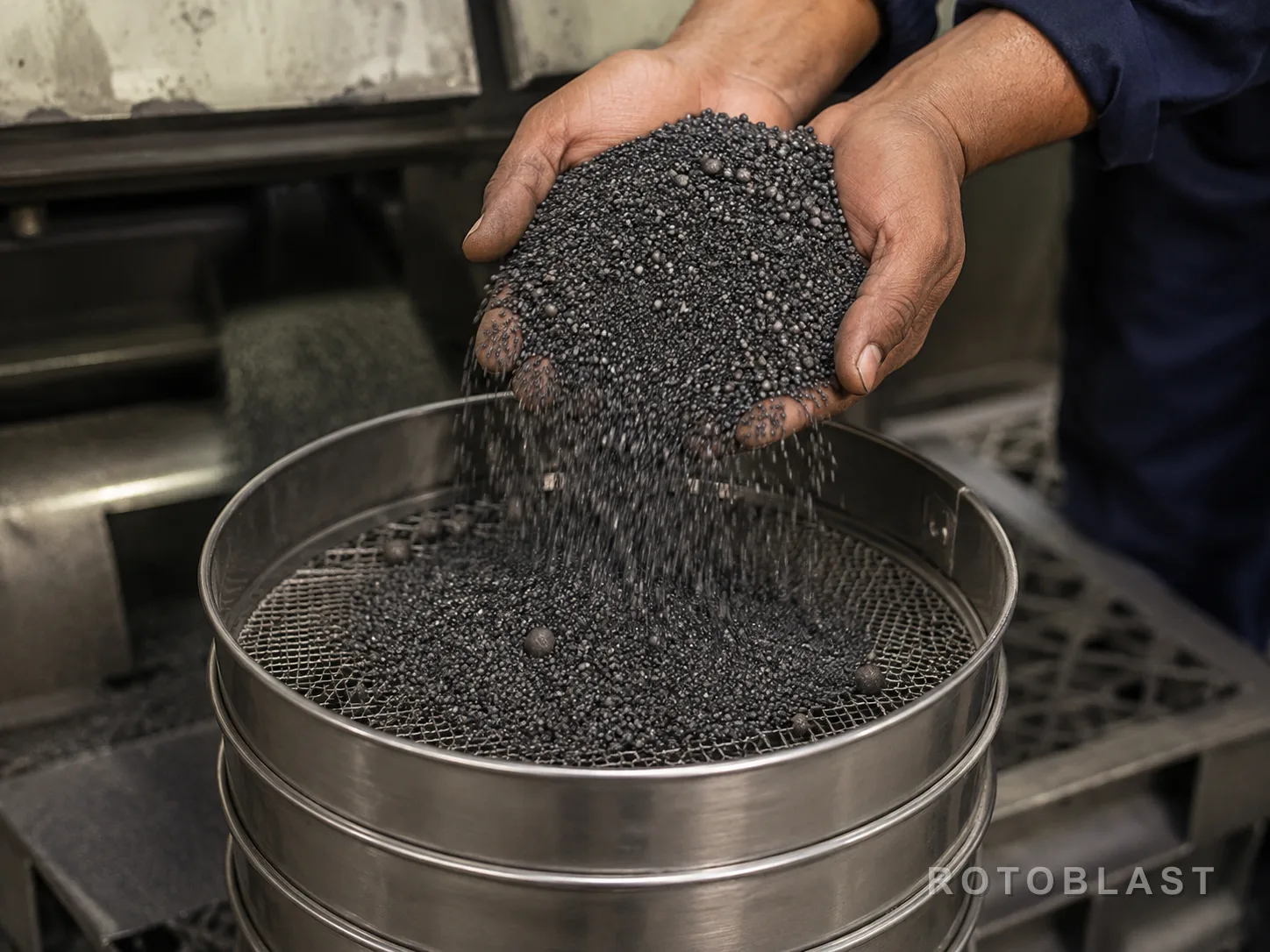
Which is why shot is topped up little and often.
Small, frequent additions keep the mix stable. A large single charge after a shutdown resets the machine towards uniform size and cleaning slows down for days until the spread rebuilds.
WHAT PLANTS ACTUALLY ASK
Six problems that are almost never the machine.
01Blasting time has increased but nothing on the machine changed.
The mix has drifted.
Usually the separator is removing too much of the smaller fraction, leaving a coarse, uniform mix with too few impacts. Sieve a sample before touching the wheels.
02Abrasive consumption jumped without a change in production.
Look at the separator, not the shot.
Most sudden consumption rises are good media leaving with the dust because the separator air setting drifted or the dust collector is pulling too hard. Broken shot is a slower, steadier climb.
03The shot is breaking up far too quickly.
Wrong hardness, or porous castings.
Shot harder than the job needs fractures instead of deforming. Internal porosity and inclusions from poor casting do the same. Both show up as a rise in fines and dust long before consumption figures move.
04Some parts come out rough while others are still dirty.
Coverage, not cleaning power.
Parts shadowing each other, or a mix too coarse to reach recesses. Larger shot cannot get into a corner a smaller particle reaches, so a load with mixed geometry needs the size set for the hardest area to reach.
05Dust has increased sharply.
Fines are being recirculated.
The separator is returning material it should be discarding. Left alone this coats the workpiece, degrades finish and loads the dust collector until extraction across the whole machine falls off.
06Does harder shot make the machine last longer?
It does the opposite.
Harder abrasive is more aggressive on blades, liners and the wheel itself. Hardness should be matched to the work — raising it to buy shot life spends that saving on wear parts instead.
Cost per tonne processed is the only number that compares two suppliers.
Price per kilogram tells you nothing about how many kilograms you will use. Track kilograms of abrasive against tonnes of work, in one machine, over a full month — the cheaper delivery is often the more expensive year.
SPECIFICATION & SUPPLY
What to put on the order.
Supplied from Faridabad, India to foundries, fabrication companies and OEM manufacturers in India and across the UAE.
- Type
- Cast high-carbon steel shot
- Size standard
- SAE J444
- Metallurgical standard
- SAE J827
- Common grades
- S110 – S660
- Working hardness
- 40 – 50 HRC
- Microstructure
- Uniformly tempered martensite
Lead time
Indicative only, and dependent on grade, quantity and production scheduling. A confirmed schedule is issued at order confirmation.
What support covers
- Grade selection for your components
- Operating mix review
- Separator setting guidance
- Consumption tracking method
- Long-term technical assistance
Send a sample, not a specification.
A sieve test on shot drawn from your running machine says more than any datasheet. Send a sample with the component you are cleaning, and an engineer will tell you whether the grade, the mix or the separator is what needs changing.
Request a quote
Tell us your application, part size and throughput — we'll respond with a specification and price.
Faridabad, Haryana, India
Mon–Sat, 9:30 AM – 6:30 PM IST