
Tumblast Shot Blasting Machine
Engineered for High-Volume Batch Cleaning of Castings, Forgings and Fabricated Components
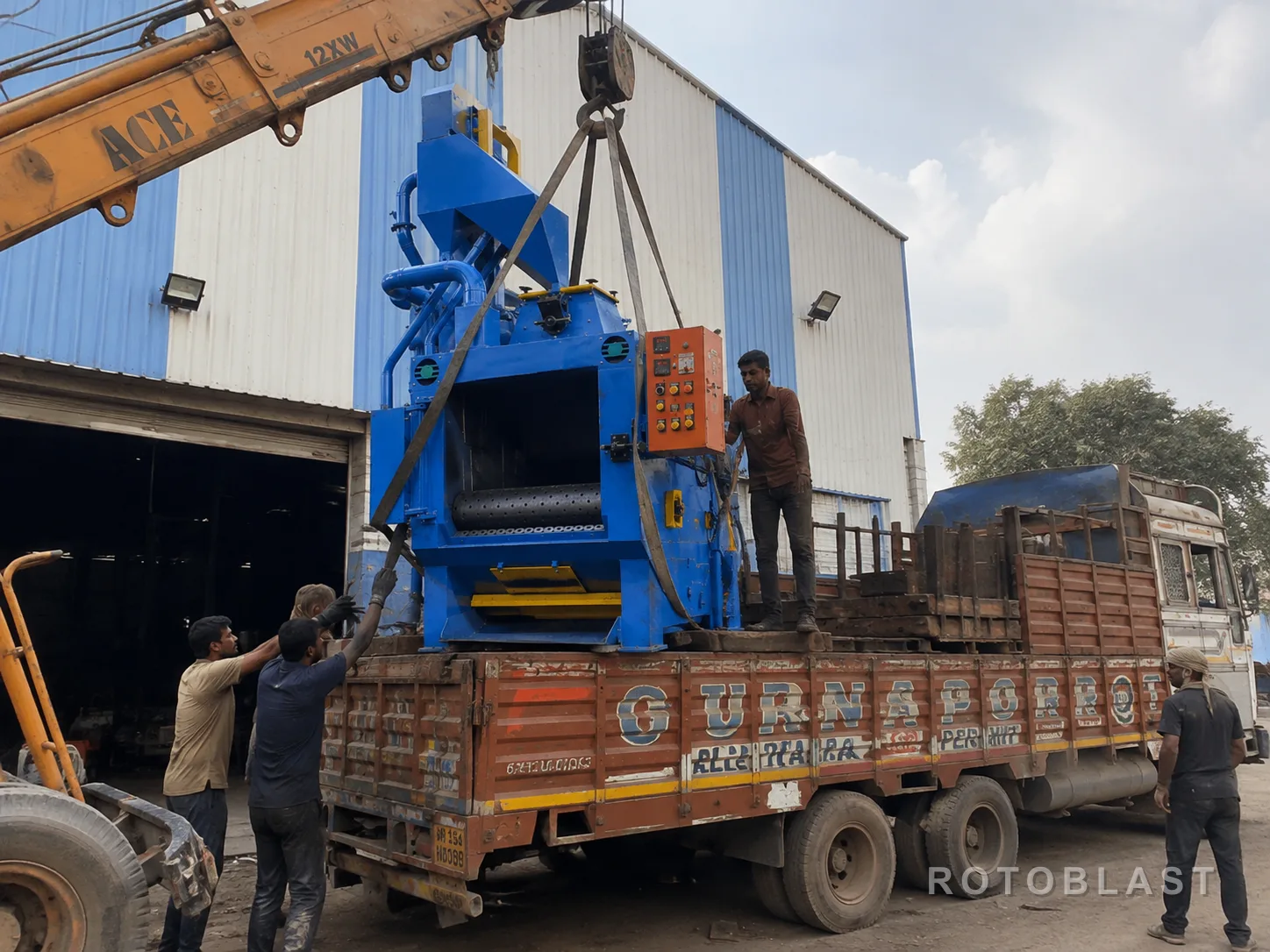
WHAT IT DOES
A Tumblast machine is intended for batch processing, not continuous conveyor production.
In every foundry or fabrication unit, there comes a point where manual blasting becomes inconsistent, expensive, and difficult to control. Components vary in shape, surface condition, and production quantity, yet every batch is expected to achieve a uniform surface finish before painting, coating, machining, or assembly.
A Tumblast Shot Blasting Machine is specifically designed to solve this production challenge by continuously tumbling multiple components inside a rotating chamber while a high-efficiency blast wheel projects steel abrasives at controlled velocity. Unlike manual blasting, every exposed surface is repeatedly presented to the abrasive stream, producing consistent cleaning across the entire batch.
For manufacturers across India and the UAE, where production schedules, abrasive consumption, and machine uptime directly influence operating costs, selecting the right Tumblast Shot Blasting Machine is far more important than selecting the largest machine. Machine geometry, blast wheel performance, separator efficiency, and wear-resistant construction determine whether the machine delivers years of reliable production or becomes a frequent maintenance burden.
HOW THE PROCESS WORKS
What Makes a Tumblast Shot Blasting Machine Different?
Instead of moving workpieces through a blasting chamber on rollers or hangers, the machine rotates a specially designed tumble belt or drum that continuously lifts and turns the components. Every rotation changes the orientation of the parts, allowing the steel shots to reach surfaces that would otherwise remain shielded.
- STAGE 01
Belt lifts the batch
The tumble belt raises components against the direction of fall.
- STAGE 02
Parts turn as they drop
Each component rolls to a new orientation instead of returning to the same face.
- STAGE 03
Shielded surfaces present
Faces that were buried a moment earlier now sit in the abrasive stream.
- STAGE 04
The cycle repeats
Over the exposure time, every exposed surface has been presented repeatedly.
The objective is not simply to remove scale. A properly designed Tumblast machine produces a predictable surface profile required for coating adhesion while minimizing unnecessary abrasive consumption.
THE ENGINEERING PRINCIPLE
Practical Engineering Principle Behind Uniform Cleaning
Many buyers assume that increasing blast wheel power automatically improves cleaning quality.
In practice, that assumption is often incorrect.
Cleaning consistency depends on the relationship between four operating factors:
- 01
Component movement inside the tumble chamber
- 02
Abrasive flow rate
- 03
Blast wheel projection angle
- 04
Exposure time
If any one of these factors is poorly balanced, the result is uneven cleaning, excessive abrasive breakdown, unnecessary wear on liners, and higher electricity consumption.
An experienced operator evaluates these parameters together rather than changing only the blasting time.
SIZING THE MACHINE
Choosing the Right Batch Capacity
Machine capacity should be selected according to the effective volume occupied by components rather than simply their total weight.
For example, lightweight fabricated components may occupy the chamber completely before reaching the rated load capacity, while compact steel forgings may utilize the full weight rating without filling the chamber.
Selecting the chamber based only on kilogram capacity often leads to reduced productivity.
Why Is Batch Loading More Important Than Machine Size?
Many buyers compare Tumblast Shot Blasting Machines by batch capacity in kilograms. In practice, experienced production engineers evaluate how the components move inside the chamber, because cleaning quality depends more on effective tumbling than on maximum load.
When a batch is overloaded, components begin to shield one another from the abrasive stream. Instead of tumbling freely, they settle into compact layers, creating dead zones where steel shots cannot strike the surface at the required impact angle. The machine may be running at full capacity, yet parts in these areas receive little or no effective cleaning.
A properly loaded batch allows every component to lift, separate, rotate, and fall naturally during the tumbling cycle. This constant movement exposes new surfaces to the blast wheel, maintains a consistent impact angle, and improves overall tumble efficiency. The result is more uniform cleaning, shorter cycle times, and lower abrasive consumption.
IF YOU PROCESS…
This tumbling action is particularly effective for:
- Steel castings
- Iron castings
- Forged components
- Heat-treated parts
- Machined components
- Valve bodies
- Automotive components
- Fasteners
- Agricultural equipment parts
- General engineering components
Applications Across India and the UAE
Tumblast Shot Blasting Machines are widely used by manufacturers producing medium and high-volume components for domestic and export markets.
Typical industries include:
- Foundries
- Automotive component manufacturers
- Steel fabrication companies
- Valve manufacturers
- Railway component manufacturers
- Agricultural equipment manufacturers
- Oil and gas equipment manufacturers
- Heavy engineering industries
- Construction equipment manufacturers
- General engineering workshops
For manufacturers in the UAE, these machines are particularly valuable in oil & gas, structural steel, and fabrication sectors where reliable surface preparation supports coating performance in demanding environments. In India, they are commonly integrated into foundries, automotive supply chains, and engineering plants seeking consistent batch cleaning with controlled operating costs.
WHERE IT IS THE WRONG MACHINE
Which Components Should NOT Be Blasted in a Tumblast Shot Blasting Machine?
A common misconception is that a Tumblast Shot Blasting Machine can clean every metal component. In reality, the machine is designed for parts that can tumble freely without compromising their geometry, surface finish, or dimensional accuracy. Components that depend on controlled orientation or have delicate surfaces are generally poor candidates for tumbling.
Avoid tumblast blasting for:
- Thin aluminium or lightweight fabricated parts
- Continuous tumbling can cause bending, denting, or edge deformation before the blasting process is complete.
- Precision-machined components
- Bearing seats, sealing faces, and close-tolerance surfaces can be damaged if they repeatedly collide with other parts during tumbling.
- Threaded precision components
- Frequent metal-to-metal contact may nick thread crests or introduce burrs that affect assembly, even if the blasting itself is appropriate.
- Mirror-finished or decorative surfaces
- Shot blasting is intended to create a controlled surface profile. It is not suitable where the original polished appearance must be preserved.
- Fragile castings or thin-section cast components
- Parts with sharp fins, unsupported ribs, or delicate projections may chip or break due to repeated impact with neighbouring workpieces during tumbling.
MACHINE SELECTION
When Should You Choose a Tumblast Shot Blasting Machine Instead of a Roller Conveyor Shot Blasting Machine?
The choice between a Tumblast Shot Blasting Machine and a Roller Conveyor Shot Blasting Machine is determined by the type of components you manufacture—not by production capacity alone.
A Tumblast machine is designed for loose, small to medium-sized components that can tumble freely during blasting, such as castings, forgings, fasteners, valve bodies, and automotive parts. As the components rotate continuously, multiple surfaces are exposed to the abrasive stream, making it an efficient solution for batch production with minimal operator involvement.
A Roller Conveyor machine, on the other hand, is intended for long, heavy, or fabricated structures that cannot tumble without damage or distortion. Steel plates, structural sections, pipes, beams, and welded assemblies pass through the blasting chamber on powered rollers, allowing continuous processing without interrupting production.
Which Machine Fits Your Production?
| Tumblast Shot Blasting Machine | Roller Conveyor Shot Blasting Machine |
|---|---|
| Best for loose and batch-loaded components | Best for long and fabricated structures |
| Batch production | Continuous production |
| Suitable for varied component sizes in one batch | Ideal for repetitive processing of similar workpieces |
| Lower operator intervention after loading | Requires controlled loading and unloading of workpieces |
| Lower initial investment for batch applications | Better return on investment for high-volume continuous production |
Practical Buying Advice
If your production involves thousands of small castings or forged components every day, a Tumblast Shot Blasting Machine generally provides the most economical and space-efficient solution. However, if your plant primarily processes steel plates, fabricated frames, H-beams, pipes, or structural assemblies, a Roller Conveyor Shot Blasting Machine delivers higher throughput and eliminates the need for batch handling.
A simple rule followed by many experienced production engineers is this: if the component can tumble safely without affecting its geometry or surface quality, a Tumblast machine is usually the right choice. If the component must retain a fixed orientation throughout blasting, a Roller Conveyor machine is the more suitable investment.
WHAT IT COSTS TO RUN
What Determines the Operating Cost of a Tumblast Shot Blasting Machine?
The purchase price of a Tumblast Shot Blasting Machine is a one-time investment. The real cost of ownership is determined by what the machine consumes and how often production is interrupted.
The largest operating costs are often hidden in daily production rather than in the machine itself.
- 01Electricity
- Power consumption depends on blast wheel loading, cycle duration, and motor efficiency. Running longer cycles than necessary increases energy costs without improving cleaning quality.
- 02Steel Shots
- Abrasive is a consumable. Poor separator performance, incorrect shot size, or unnecessary blasting time accelerates shot breakdown and increases replacement frequency.
- 03Blast Wheel Blades
- Blades wear with every abrasive impact. Uneven blade wear not only increases replacement costs but also disturbs the abrasive throw pattern, affecting cleaning consistency.
- 04Cabinet Liners
- Wear liners protect the blasting chamber. Delaying their replacement allows abrasive to attack the machine structure itself, turning a low-cost maintenance item into a major repair.
- 05Bearings
- Bearings are affected more by vibration and abrasive contamination than by operating hours. Ignoring wheel imbalance or poor sealing often shortens their service life.
- 06Labour
- Frequent batch loading, manual re-blasting, and unplanned maintenance increase labour costs even when machine performance appears acceptable.
- 07Downtime
- The most expensive cost is often a stopped production line. A machine waiting for blades, bearings, or emergency repairs can cost far more than the replacement parts themselves through missed production schedules.
Common Operational Mistakes
Many premature machine failures are caused by operating practices rather than equipment design.
Frequent examples include:
- Overloading the tumble chamber
- Using mixed abrasive sizes
- Delaying replacement of worn blades
- Operating with damaged liners
- Ignoring separator adjustments
- Running the machine with insufficient abrasive inventory
- Poor preventive lubrication
- Inadequate dust collector maintenance
Preventive inspection of wear components generally costs significantly less than unplanned production stoppages.
ENGINEERING NOTES
Tumblast Shot Blasting Machine
Engineered for High-Volume Batch Cleaning of Castings, Forgings and Fabricated Components
- 0+
- Years of engineering
- 0+
- Tumblast machines delivered
- 0+
- Plants served
- 0+
- Industries served
Request a quote
Tell us your application, part size and throughput — we'll respond with a specification and price.
Faridabad, Haryana, India
Mon–Sat, 9:30 AM – 6:30 PM IST