TABLE TYPE · ROTARY BATCH BLASTING
It cleans what it can see.
Overhead wheels blast the face pointing up at them. Understand that one sentence and you already know whether this is the right machine for your components — and most of what it will cost you to run.
- Table diameter
- 800 – 2000 mm
- Load
- 500 – 2000 kg
- Finish
- Sa 2 – Sa 2.5
THE ONE LIMIT THAT DECIDES EVERYTHING
One face at a time.
Wheels are mounted above the table and throw downward. Whatever surface points up gets cleaned; whatever sits underneath, or hides behind another part, does not. There is no mechanism in a table machine that turns your component over.
- 01
Flat, single-sided work runs in one pass
Base plates, flanges, gear blanks, cover plates, weldments finished on one side — anything where the face that matters is the face pointing up.
- 02
Two-sided work is a two-pass cycle
The part is blasted, the machine is stopped, the part is turned, and it runs again. That turn is real time and real labour, and it belongs in your cost calculation before the order, not after.
- 03
Deep recesses and undercuts stay shadowed
Abrasive travels in straight lines from the wheel. A pocket the stream cannot enter will not clean, however long the cycle runs.
This is not a weakness. It is the specification — and it is why the machine is simple, robust and inexpensive to own.
BEFORE YOU COMPARE PRICES
Match the machine to how the part behaves, not to the budget.
Three wheel-blast configurations cover most foundry and fabrication work. They are not tiers of quality and a table machine is not a cheaper hanger — they handle parts differently, and picking on price is how plants end up turning components by hand for the next ten years.
Heavy single pieces, flat, one face matters
The table's core case. Load with a crane, blast, remove.
Small parts in bulk, robust enough to tumble
Tumbling exposes every face without handling each piece.
All-round cleaning needed on one part
Hanging presents every face to the wheels in one cycle.
Fragile or machined parts that must not knock
Tumbling would damage them; the table holds them still.
Low to medium batch volume, mixed part sizes
A table takes whatever fits inside its diameter and height.
If more than one row above describes your work, the honest answer may be two machines rather than one compromise.
WHAT ACTUALLY LIMITS OUTPUT
On a table machine, blasting is rarely the slow part.
Wheel power sets how long the blast takes. Everything around the blast — craning the part in, positioning it, opening and closing, turning it for the second face, craning it out — is handling. On most table installations handling is the larger number, which changes what you should be specifying.
Proportions are illustrative of a two-pass cycle, not measured output. Time your own load and unload once with a stopwatch — it is usually the most revealing five minutes anyone spends on this decision.
- Specify the door and the diameter before the kilowatts
- A table that fits the part with room for the sling, and an opening a crane can reach into cleanly, saves more minutes per cycle than a larger wheel motor will.
- A second wheel shortens blasting, not the cycle
- Adding wheel power compresses the part of the cycle that was already the smaller half. Worth doing when blast time genuinely dominates — worth checking first.
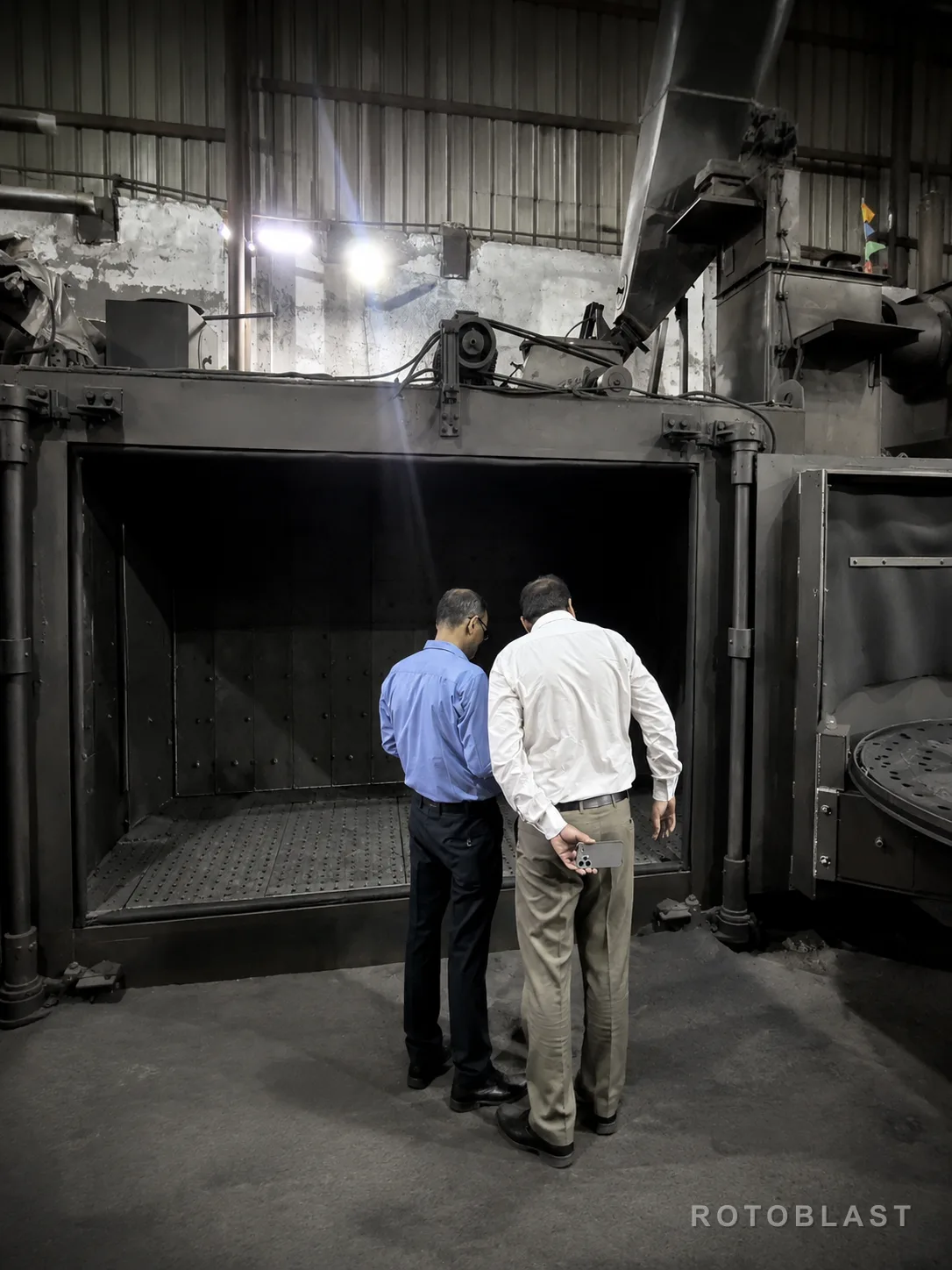
SPECIFICATION
The build range, and what it commits you to.
Working envelope
- Table diameter
- 800 – 2000 mm
- Maximum load
- 500 – 2000 kg
- Maximum part height
- 300 – 800 mm
Blast system
- Blast wheels
- 1 – 3, direct drive
- Wheel motor power
- 7.5 – 15 kW each
- Abrasive velocity
- 65 – 80 m/s
Utilities and install
- Power supply
- 415 V, 3-phase, 50 Hz
- Foundation
- Floor-mounted, minimal civil work
- Typical finish
- Sa 2 – Sa 2.5
If your coating specification calls for Sa 2.5, say so at enquiry.
Sa 2 and Sa 2.5 are blast-cleaning grades under ISO 8501-1; Sa 2.5 requires at least 95% of each area free of visible mill scale and rust. A table machine reaches it on exposed faces with the right abrasive and cycle time, but it is a cycle and specification question, not something every configuration delivers by default.
What wears, and roughly when you will notice
- Blast wheel blades
- Replaced as a matched set. Uneven cleaning across the table is usually the first sign.
- Control cage
- Sets where the pattern lands. A drifted clean spot points here before it points at the wheel.
- Cabinet liners
- Sacrificial. They take the rebound so the cabinet shell does not.
- Table seals and bearings
- Abrasive ingress is the usual failure route. Rough or noisy rotation is the warning.
ASKED BEFORE EVERY ORDER
The six that decide it.
- 01
Can one table machine handle all our components?
Only if they share a working face. Parts cleaned on one side run in a single pass; parts needing all-round coverage need turning, and very small bulk parts are better suited to a tumblast. Mixed work is normal — plan the cycle around the hardest part, not the easiest.
- 02
How do we size the table for our parts?
Take the largest component you will ever run, add clearance for slinging and for the part not sitting perfectly centred, and specify against that. Table diameter is fixed at manufacture; a part that overhangs cannot be blasted evenly.
- 03
Does more wheel power mean shorter cycles?
It shortens the blasting portion only. Where handling dominates the cycle, extra kilowatts add running cost without adding throughput. Time your load and unload before deciding how many wheels to specify.
- 04
What surface finish can we hold consistently?
Sa 2 to Sa 2.5 on exposed faces, with the correct abrasive grade and a cycle long enough for full coverage. Consistency depends more on maintaining a stable abrasive operating mix than on the machine itself.
- 05
How much civil work does installation need?
Far less than a pass-through line. The machine is floor-mounted and needs minimal foundation work, which is one of the practical reasons it suits plants adding blasting for the first time or fitting it into an existing bay.
- 06
What does it cost to run?
Three things, in order: abrasive consumed, wear parts, and electricity for the wheel motors and dust collector. Track abrasive in kilograms per tonne processed rather than per shift — it is the only figure that lets you compare one month against another honestly.
SUPPLY & SUPPORT
Built in Faridabad. Supplied to India and the UAE.
Machines are engineered and built at our works in Faridabad, India, and supplied to foundries, job shops, fabrication companies and OEM manufacturers in India and across the UAE.
Manufacturing lead time
Indicative only. Actual delivery depends on table size, wheel configuration, customisation, production scheduling and material availability. A confirmed manufacturing and delivery schedule is issued at order confirmation.
What support covers
- Table sizing against your components
- Installation
- Commissioning
- Operator guidance
- Cycle and abrasive optimisation
- Troubleshooting
- Long-term technical assistance
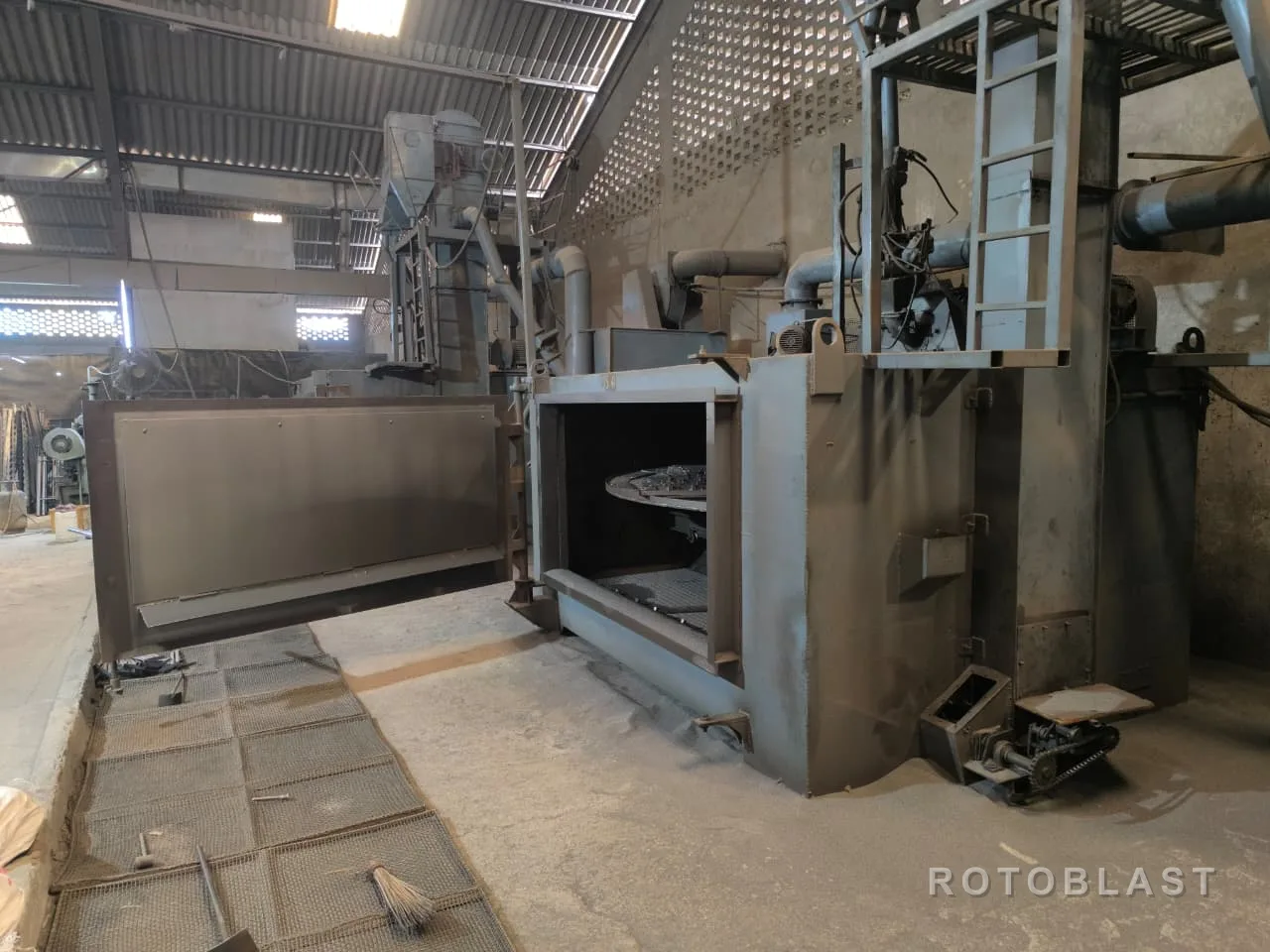
Send the part drawing, not the machine size.
Table diameter, wheel count and cycle all follow from the component. Send the drawing or a photograph with weight and the faces that must be cleaned, and an engineer will tell you whether a table machine is the right answer — including when it is not.
Also worth reading
- Blast wheel assembliesThe overhead wheels, and what decides their throw pattern.
- Tumblast shot blasting machineThe other batch machine — for loose parts that can tumble rather than sit flat.
- Roller conveyor shot blasting machine
- Spinner hanger shot blasting machine
- Steel shotGrade and operating mix set the finish more than the machine does.
- 0+
- Years of engineering
- 0+
- Table Type machines delivered
- 0+
- Plants served
- 0+
- Industries served
Request a quote
Tell us your application, part size and throughput — we'll respond with a specification and price.
Faridabad, Haryana, India
Mon–Sat, 9:30 AM – 6:30 PM IST