DUST COLLECTOR FAN IMPELLER · WEAR PART
It never stops. It just gets worse at it.
A fan impeller does not seize, trip or break down. It erodes quietly for months while the collector keeps running, and by the time anyone measures the airflow the hoods have been pulling badly for two shifts a day.
Worse: as the wheel wears it draws LESS current, not more. Maintenance reads falling amps as a fan running easy. It means a fan moving nothing.
Send us your impeller drawing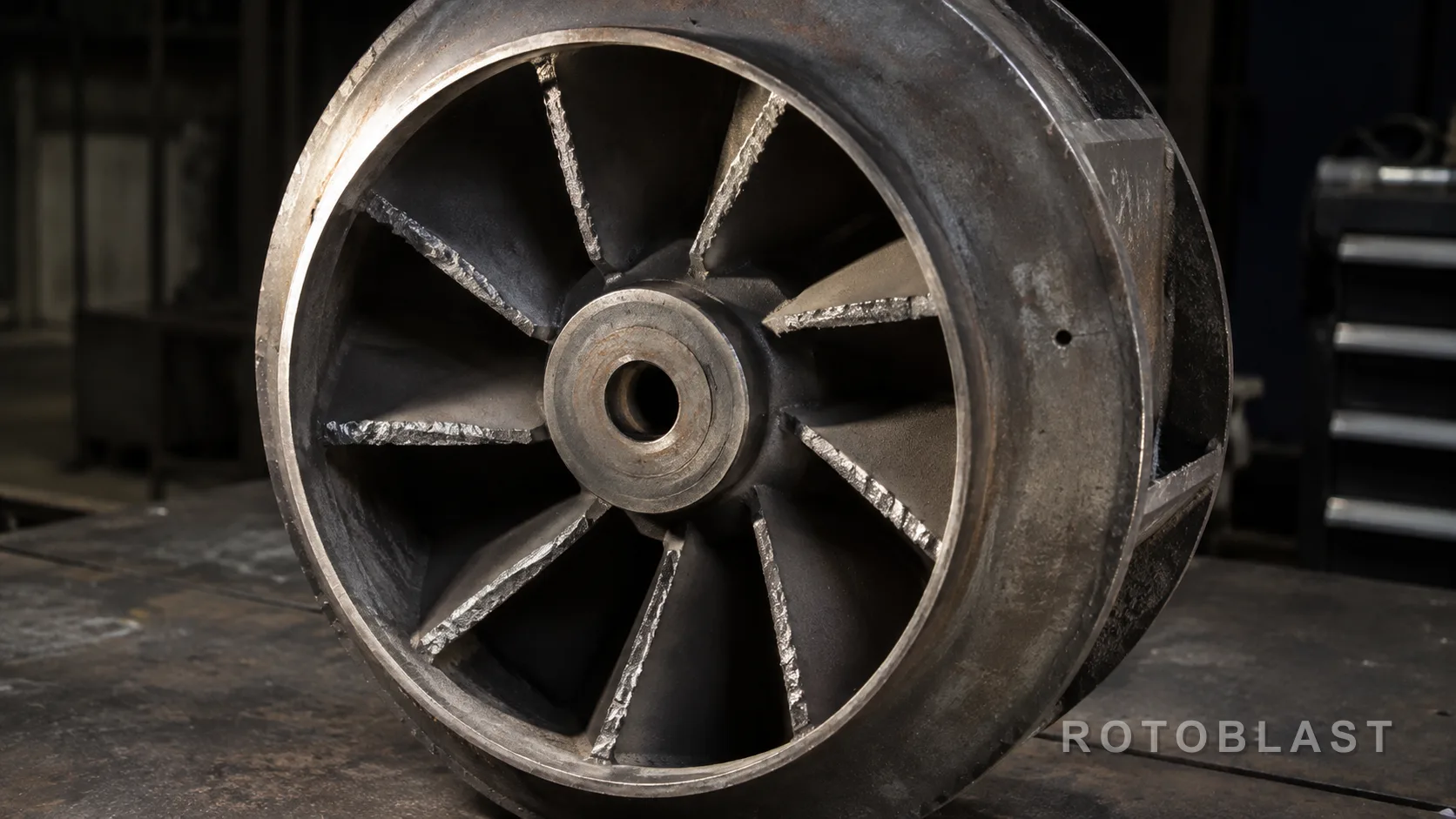
WHERE IT SITS
The fan pulls. It does not blow.
Almost every industrial dust collector is induced draft. The fan sits at the end of the system and pulls air through everything ahead of it. That single fact decides what the impeller is exposed to, and it is the fact most buyers have never been told.
Hood
Dust is captured at the machine.
Duct
Dirty air travels to the collector.
Filters
Bags or cartridges take the dust out.
Fan
The impeller pulls the whole system. It should see clean air.
Stack
Filtered air leaves.
Not the impeller inside your blast wheel
A shot blasting machine has two parts called an impeller. The small one sits inside the blast wheel and feeds abrasive to the blades. This is the other one — the fan wheel in the dust collector, usually a metre or more across, that moves the air. They wear differently, they fail differently, and they are not interchangeable.
The blast wheel sideTHE READING THAT FOOLS YOU
A worn impeller draws fewer amps.
This is the reason impeller wear is caught late in almost every plant. A fan's power draw is its airflow multiplied by the pressure it develops, divided by how efficiently it does it. Erode the wheel and it develops less pressure. Less pressure moves less air. Less air and less pressure together mean less power.
- Airflow100%
- Static pressure100%
- Motor current · the one you watch100%
Percentages are relative to the fan’s design point and are indicative. The real figures come from your own fan curve.
Drag to erode the wheel. Watch all three readings.
New wheel
Full blade width. The wheel develops the pressure it was designed for, so the hoods pull at the capture velocity the system was sized around.
Measure the pressure drop, not the amps
Put a manometer across the collector and record it when the machine is commissioned or when new filters go in. That number is your baseline, and tracking it is the cheapest preventive maintenance you can put on a collector. Airflow efficiency drops show up there long before anything shows up on a clamp meter, and a falling current reading tells you nothing on its own.
TWO FAILURES, ONE SYMPTOM
Vibration does not tell you which problem you have.
Fan wear is not one condition. An impeller goes out of balance two ways and they are opposites: one takes metal off, the other puts material on. Both read as vibration on a handheld meter, and the correct response to each is the reverse of the other.
Mass removed
Abrasive dust has cut the leading edges away. The wheel is lighter on the side that took the wear, and thinner everywhere the dust struck. It will not come back with cleaning.
What to do
Replace the wheel. Then find out why abrasive reached it at all.
Cleaning an eroded wheel achieves nothing and puts a thin blade back into service.
How to tell them apart before you order anything
Open the inspection door and look at the blade edges with a torch. Eroded blades are thin, bright and often scalloped where the dust struck hardest. Caked blades are the original thickness under a dull crust you can chip with a screwdriver. Two minutes of looking decides whether you are buying a wheel or booking a clean.
WHAT EROSION ACTUALLY MEANS
A worn wheel on the clean side is a filter problem.
Work back through the airflow path. On an induced-draft collector the fan sits after the filters. Abrasive dust is supposed to be trapped before it ever gets there. So if the wheel is eroded, dust is bypassing your filtration — and the fan is just where the evidence collected.
A split bag or cracked cartridge
One failed element is enough. It passes dust continuously and nothing upstream shows it.
A failed tubesheet seal or snapband
Dust takes the gap around the filter instead of going through it. Common after a rushed filter change.
A door seal or access panel leaking on the dirty side
Draws unfiltered air straight past the media.
Carryover the filters were never sized for
Heavy spent abrasive fines reaching the collector because a pre-separator or settling chamber is full or bypassed.
Unless your fan is on the dirty side
A few systems are built the other way round, with the fan blowing into the collector instead of pulling through it. On those the wheel handles raw dust by design, so erosion is ordinary wear and tells you nothing about your filters. Check which arrangement you have before you go looking for a leak: if the fan is between the hoods and the filter housing, it is a dirty-side fan and it will wear whatever you do.
Fit a new wheel without finding the leak and you buy the same wheel again
This is the most expensive mistake on this page. The impeller is a symptom. Replace it, restart, and the same dust cuts the same edges on the same schedule. Change the filters and the seals first, or at least at the same time.
BLADE SHAPE
The efficient wheel is the wrong wheel here.
Fan wheels come in three broad blade shapes, and the choice is a straight trade between efficiency and survival. For a blasting or foundry collector, the most efficient option is the one you should not fit.
Radial / paddle
Use for abrasive dust
Around 60%, up to about 75% with the blade curved at the heel
Straight blades, six to sixteen of them, with large running clearances. Built for severe duty and abrasive or corrosive material. Straight blades also stay cleaner than curved ones in dusty air, because there is no pocket for deposit to sit in.
You pay for it in efficiency and in noise.
Backward curved
Not for abrasive dust
Roughly 80–90%, the highest of any centrifugal wheel
The efficient, quiet choice, and it is non-overloading, so the motor is safe across the range. Published guidance is explicit that it is not for dusty or sticky air: residue collects on the blade surface, throws the wheel out of balance, and takes the bearings with it. Thin airfoil versions also erode.
Fitted to an abrasive duty, its efficiency advantage lasts until the first crust forms.
Forward curved
Not for abrasive dust
Up to about 75%
Twenty-four to sixty-four short, shallow blades. Compact and quiet, and it overloads — power climbs as flow climbs, so a change in system resistance can push the motor past its rating. Far too many small pockets to keep clean on dirty air.
Belongs on clean-air HVAC duty, not on a collector behind a blast machine.
Which is why blasting collectors run paddle wheels
It is not a cost decision. A radial wheel is chosen because it tolerates the solids that reach it, keeps its balance in dirty air, and can be built with enough blade thickness to have something to give away to erosion. Efficiency you can buy back with duct design. A wheel that cakes and destroys bearings you cannot.
BALANCING
A new wheel is not a balanced wheel.
A fan impeller is a large mass turning fast, so a small error in weight distribution becomes a large force at the bearings. Fan balancing is not a finishing touch: it is why a replacement wheel is balanced before it ships, and why a repaired wheel goes back on the machine afterwards.
01
Balance grades are a standard, not an opinion
ISO 21940 — the standard that replaced ISO 1940 — defines the balance grades used for rotating machinery. G6.3 is the grade normally specified for fan wheels. Ask for the grade on the paperwork, not a claim that the wheel was balanced.
02
Static balance is not enough
A wheel can sit still on knife edges and still shake at speed, because the two ends of the wheel are out in opposite directions. Fan wheels are wide enough to need dynamic balancing, correcting in two planes at running speed.
03
Weld on the wheel and you have unbalanced it
Patching an eroded blade adds metal in one place. Any repair — a weld, a wear strip, a replaced blade — puts the wheel back on the balancing machine before it goes back in the housing.
04
Bearings pay for imbalance, not the wheel
The out-of-balance force goes into the shaft and bearings on every rotation, at running speed, for as long as the fan runs. The wheel usually survives. The bearings are what fail, and they fail as an unplanned stop.
INSPECTION
Four checks, and only one needs the fan stopped.
There is no honest hour figure for impeller life. It depends on how much dust reaches the wheel, how abrasive it is, and how many hours the collector runs. So inspect on a routine and change on condition. These four checks are the whole of dust collector maintenance as far as the fan is concerned, and two of them take under a minute.
When
What you check
Why
Fan
Weekly
Record the pressure drop across the filters
This is the number that moves first. Compare it to the baseline you took at commissioning, not to last week.
Running
Weekly
Take a vibration reading at both bearing housings
Compare against a baseline. A rising trend is worth more than any single reading, and it is the earliest warning of imbalance you will get.
Running
Monthly
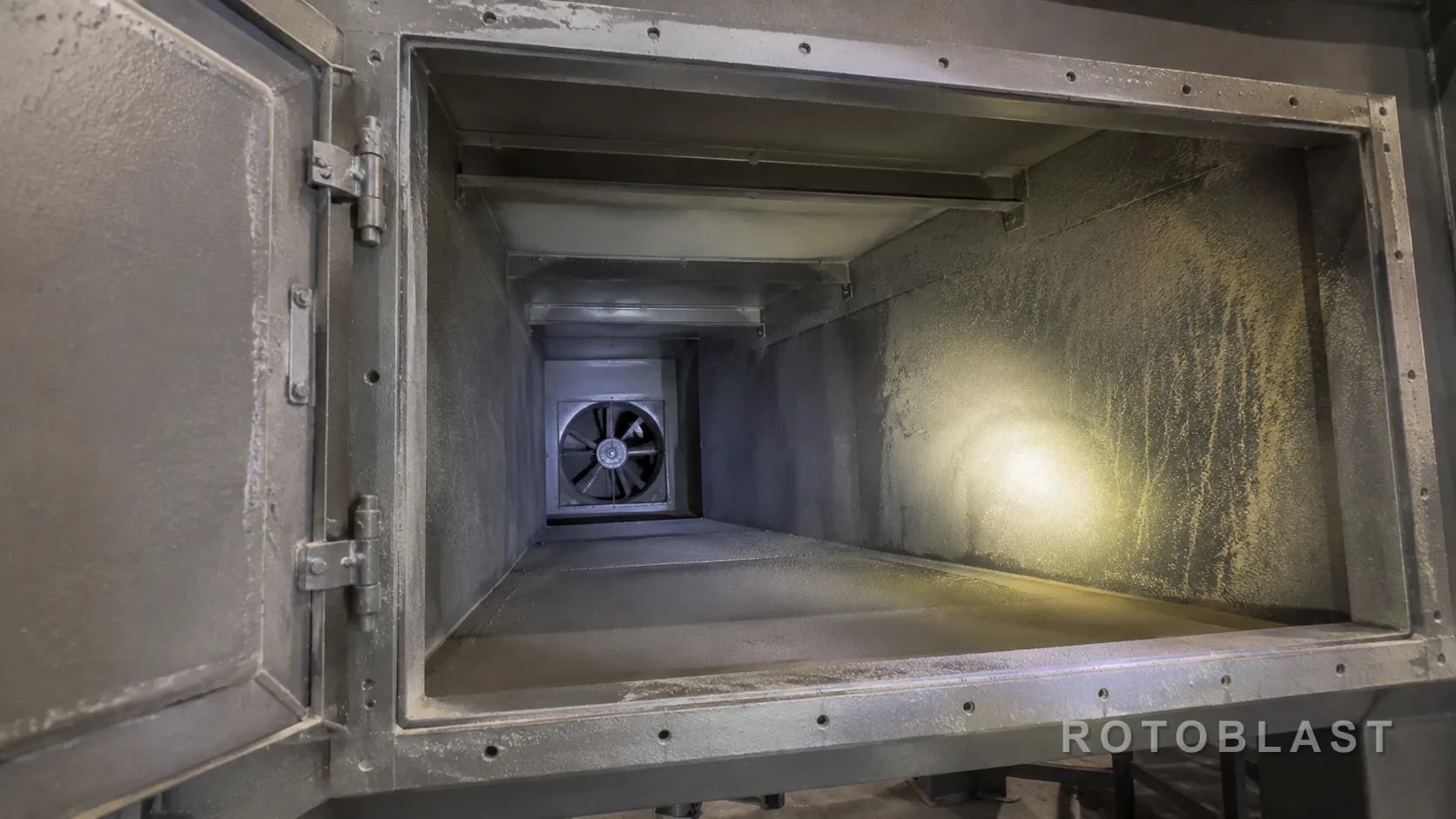
Look into the clean-air plenum
Any dust where there should be none means filtration is bypassing, and the wheel is being fed abrasive right now.
Stopped
Quarterly, and after any filter failure
Open the fan inspection door and look at the blade edges
Thin, bright, scalloped edges are erosion. A dull crust is build-up. This is the only check that tells you which of the two you are dealing with.
Stopped
Before the inspection door opens
Isolate and lock off, and let the wheel come to a complete stop. A fan impeller of this size free-wheels for a long time on induced draft after the motor is switched off, and it will keep turning on system draught alone.
REPAIR OR REPLACE
When a wheel is worth saving, and when it is not.
Not every worn impeller needs replacing, and not every damaged one can be repaired safely. Industrial fan repair is worth doing when the wheel still has sound metal to work with. Past that line, fan impeller replacement is the cheaper answer, and the line falls in a predictable place.
Worth repairing
- Even, moderate wear with the blade still at a safe thickness.
- Localised damage from a single foreign object, on an otherwise sound wheel.
- Build-up only, with no metal loss underneath it.
- A wheel that can go back on a balancing machine afterwards.
Replace it
- Blade edges thinned to the point of flexing, or scalloped through.
- Any crack, in a blade or at a blade-to-backplate weld.
- Erosion into the backplate or the shroud, not just the blades.
- A wheel already repaired once in the same area.
- Corrosion pitting across the blade faces.
The one that ends the argument
A crack is not a wear condition. A wheel this size at running speed holds real energy, and a blade that leaves the hub takes the housing with it. Cracks are replaced, not welded, whatever the wheel cost.
SUPPLY & FITMENT
We build to your wheel, or to your drawing.
An industrial fan impeller is not a catalogue item. Diameter, width, blade count, shaft bore, keyway and hub position all belong to your specific fan, and they differ between builders and between generations of the same builder.
01
Wheel diameter and width
Measured across the outside of the blades and across the wheel face. These two narrow it faster than any nameplate.
02
Shaft bore and keyway
Bore diameter, keyway width and depth. Photograph the hub with a rule across it.
03
Blade count and shape
Count the blades and say whether they are straight or curved. A photograph into the inlet eye shows both.
04
Running speed and motor rating
From the fan or motor nameplate. This is what the wheel gets balanced and stress-checked against.
We manufacture dust collector fan impellers and the rest of the dust collector spares at our own works in Faridabad, India, and supply them to foundries, steel plants, fabricators and dust collection service companies across India and the UAE. Where the fan is an imported make or the drawings are long gone, we work from your old wheel.
Lead time
Depends on wheel size, blade count and production scheduling. A confirmed date is given at order confirmation.
What we handle beyond the wheel
- Reverse engineering from a worn wheel or a photograph
- Dynamic balancing before dispatch
- Matching blade shape to the dust you are actually handling
- The rest of your dust collector spare parts on one order
DUST COLLECTOR TROUBLESHOOTING
The questions that come before a purchase order.
NEXT STEP
Send the wheel or send the numbers.
Four measurements and the fan nameplate are enough for us to quote the right impeller. If the collector is down and measuring is awkward, ship us the worn wheel and we will reverse engineer it.
Request a quote
Tell us your application, part size and throughput — we'll respond with a specification and price.
Faridabad, Haryana, India
Mon–Sat, 9:30 AM – 6:30 PM IST