Everything the machine does, the wheel decides.
One component sets velocity, pattern and consistency. Everything downstream is consequence.
WHY IT MATTERS
Cabinet, conveyor, elevator and dust system all exist to serve a single event — abrasive leaving the wheel.
- 01
Velocity
Wheel speed and blade length set impact energy. Every cleaning rate quoted for a machine is derived from this number, not from cabinet size.
- 02
Pattern
The control cage aims the stream. Where that pattern lands decides whether a part is cleaned evenly or polished in one strip.
- 03
Consistency
Balance and wear rate decide whether hour eight matches hour one. A machine drifts out of specification at the wheel first.
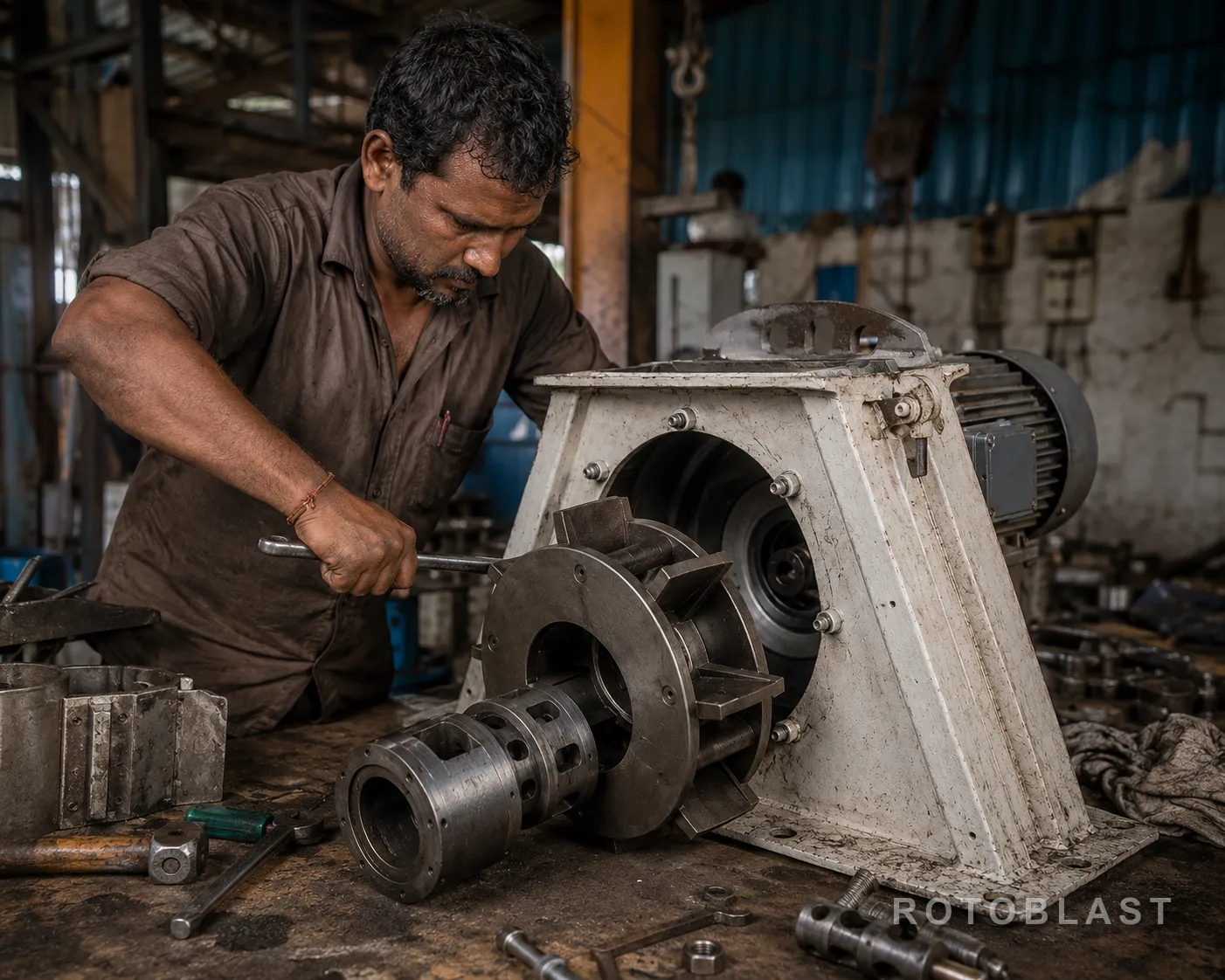
Everything downstream of the wheel is consequence, not cause.
So how does a wheel throw steel at seventy metres per second?
HOW IT WORKS
One event, four decisions.
01 · Feed
Abrasive falls through the feed spout into the centre of the wheel, still moving slowly.
02 · Aim
The control cage releases it through one window. That window is what aims the blast.
03 · Accelerate
Blades carry the shot outward, accelerating it along their length until it leaves the rim.
04 · Pattern
The stream resolves into a pattern on the workpiece. Cleaning happens where that pattern is dense.
Four decisions, and only one of them is speed.
Explore the engineering explanationWHAT AN ENGINEER NOTICES FIRST
Blast wheels rarely fail suddenly. They announce it.
The blades are not wearing evenly.
Uneven blade wear is usually a symptom, not the root cause. It points at feed distribution or cage timing long before it points at blade quality.
Look at which blades are worn and by how much. A single heavily worn blade usually means a feed spout delivering off-centre. Alternating wear across opposite blades points at the cage window. Uniform wear that is simply fast is the only case where the blade material itself is the honest answer.
The clean spot has drifted off centre.
The wheel has not slowed down. The cage has moved, and the pattern moved with it.
Cage timing is set in degrees, and a few degrees is the difference between a part cleaned edge to edge and a part polished in one strip. Cages shift when their locking hardware relaxes, and they wear at the window edge. Both change the aim without changing anything you can hear.
Abrasive consumption is climbing quietly.
Abrasive rarely disappears where people look for it. Most of it leaves through the separator and the dust collector, not the cabinet seals.
A rising consumption figure is a measurement problem before it is a machine problem. Track kilograms per tonne processed, not per shift. Once you have that number, the separator air setting, the shot size mix and the liner condition each explain a different part of the climb.
There is a new note in the vibration.
Vibration has a signature, and the signature names the part. A change in pitch is worth more diagnostically than a change in amplitude.
Low and rhythmic usually means balance — a blade set that no longer matches in mass. Higher and constant points at bearings. Intermittent and sharp is almost always something loose in the housing. An engineer listens before opening anything, because opening the housing destroys the evidence.
Why Are Your Blast Wheel Blades Wearing Unevenly?
Uneven blade wear is rarely caused by blade quality alone. The condition of the control cage, wheel hub, impeller, abrasive feed, and wheel balance collectively determine blade life, cleaning consistency, and machine operating cost. Understanding each component makes troubleshooting faster and far more accurate.
Start With the AssemblyTHE ASSEMBLY
HOW TO CHOOSE
Four questions that decide it. None of them is a model number.
Match the wheel to the work, not the machine.
Component mass, hardness and contamination set the energy you need. A wheel specified from the machine's model number rather than the part being cleaned is the most common and most expensive mismatch in the industry.
Throw pattern beats raw power.
A larger wheel aimed badly cleans less than a smaller wheel aimed well, and costs more to run doing it. Ask how the pattern is set and verified before asking what the motor draws.
Balance is a purchase decision, not a maintenance one.
Balance is machined in, not corrected later. Ask whether blades are supplied as matched sets, whether the assembly is dynamically balanced, and to what tolerance. A vague answer is itself an answer.
Wear parts define the real cost.
Purchase price is the smallest number in the life of an assembly. Blades, cage and liners will cost several times the wheel over five years, so the price and availability of those parts is the specification that matters.
The same part, two wheels.
Undersized wheel
Dense in the centre, starved at the edges. The operator compensates with time.
Pattern shown on a flat plate. Real geometry changes the shape, never the principle.
Tell us the symptom. We'll tell you the part.
Most blast wheel problems are diagnosed in a conversation, not a catalogue. Tell us the machine, the symptom and what changed, and an engineer will tell you which component is actually responsible.
Request a quote
Tell us your application, part size and throughput — we'll respond with a specification and price.
Faridabad, Haryana, India
Mon–Sat, 9:30 AM – 6:30 PM IST