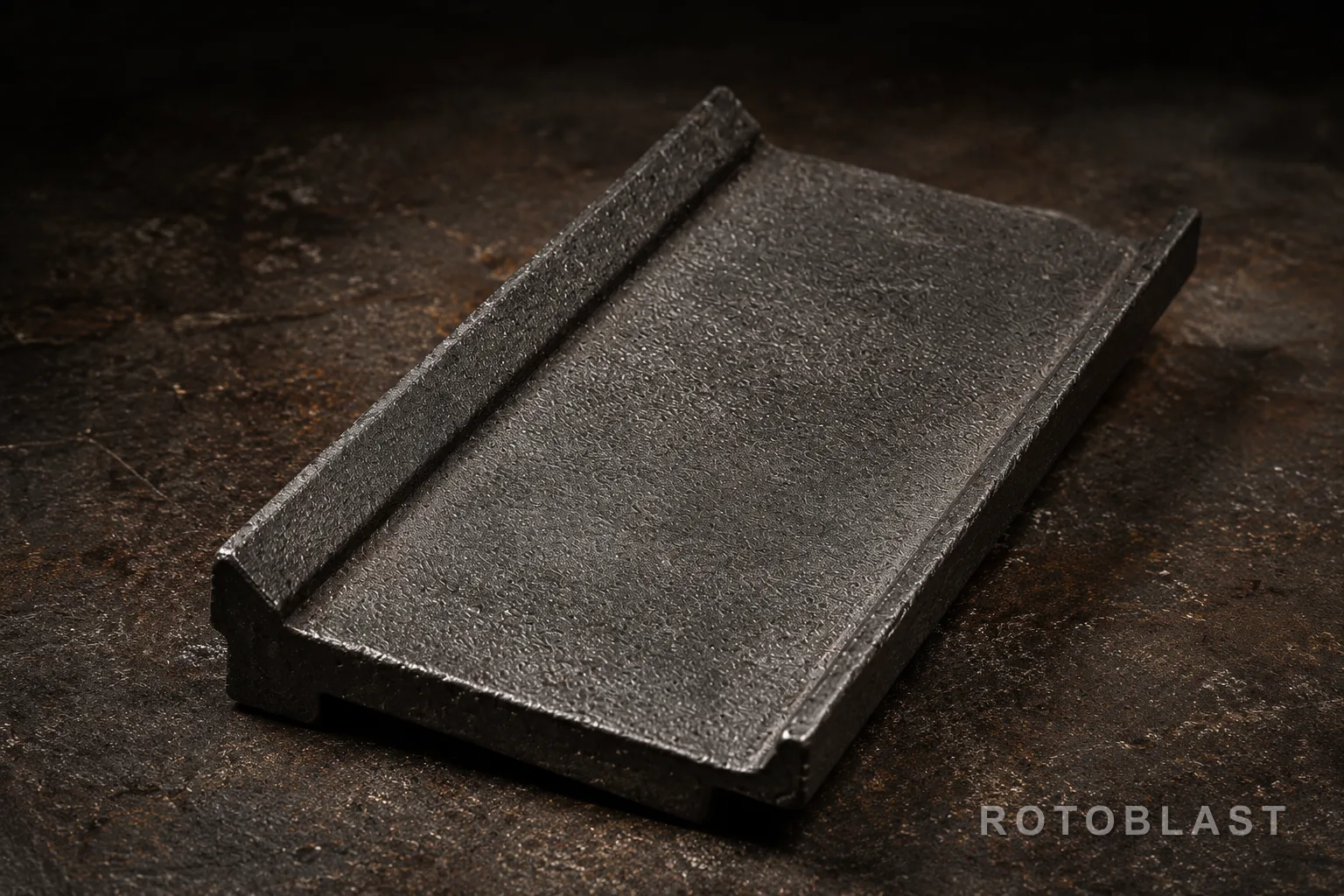
HEAVY DUTY BLADES · HIGH CHROME
Hard enough to keep its shape.
A blast wheel blade does not snap. It slowly wears at the face. Once that face changes shape, your blast pattern moves and your cleaning goes uneven. Hardness is what slows that down.
64HRC
Approximate hardness, by design
HRC is the scale used to measure how hard metal is. About 64 is near the top end for a wear part.
WHAT ACTUALLY GOES WRONG
Blades do not break. They lose their shape.
Abrasive slides along the blade face every time the wheel turns. That sliding slowly cuts the face away. The blade still looks fine. But it is no longer the shape it was, and that is the part that costs you.
01 · New
The face is the shape it was designed to be. Abrasive leaves the blade where it should.
02 · Worn face
The face has been cut away. It is still a blade. It is not the same blade.
03 · Pattern moves
Abrasive now leaves at a slightly different angle. The clean spot shifts on the part.
04 · Quality drifts
Some areas get blasted twice. Some get missed. Nobody changed a setting.
This is why cleaning gets worse before the blade looks finished
Most plants change blades when they look worn out. By then the pattern has been drifting for weeks. Operators compensate by running parts longer, so you pay in cycle time and abrasive before you ever pay for a blade.
WHY THIS MATERIAL
The blade has to be harder than what is running over it.
Think about what is happening on the blade face. Steel shot is sliding across it at speed, thousands of times a minute. If the blade is softer than the shot, the shot cuts into it. If the blade is harder, the shot slides over instead.
- High Chrome
- Chrome forms very hard particles inside the metal as it is cast.
- Those particles are harder than your abrasive. The shot cannot cut them, so it slides over the face instead of digging into it. The shape lasts longer, so your blast pattern stays where it was set.
- Around 64 HRC
- HRC is the scale used for metal hardness. Around 64 is near the top end for a wear part.
- It puts the blade on the right side of that sliding contact. In daily terms it means fewer blade changes, fewer stoppages, and a finish that stays the same from Monday to Friday.
One honest limit
Hard metal is also less forgiving. If a nut, a bolt or a piece of a broken part gets into the wheel, a hard blade can chip where a softer one might have bent. That is an argument for keeping foreign objects out of your abrasive, not for fitting a softer blade.
THE MISTAKE THAT COSTS BEARINGS
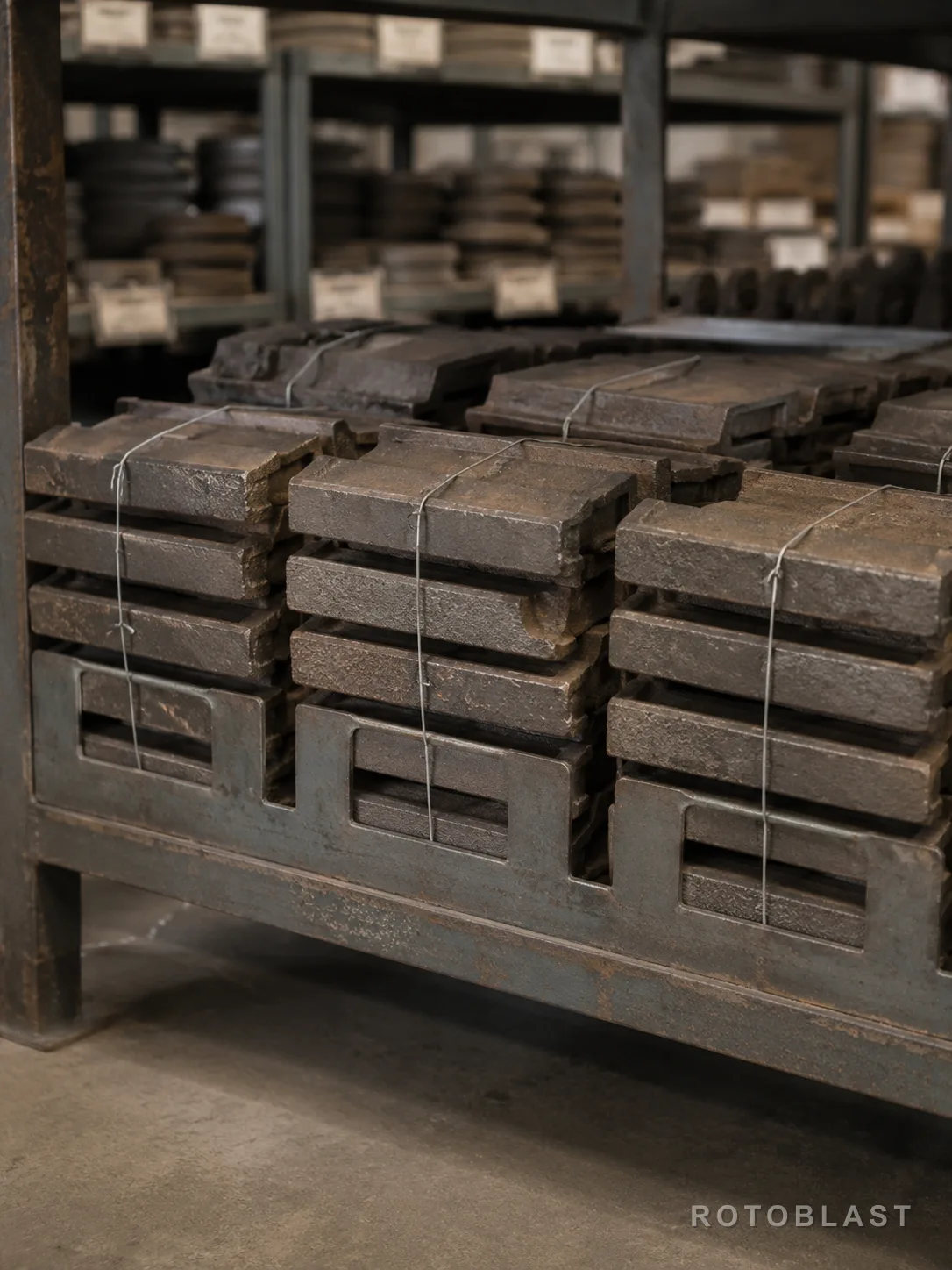
Never change one blade on its own.
A blast wheel spins fast. Every blade on it has to weigh close to the same. Fit one new blade next to worn ones and that side is now heavier. The wheel is out of balance from the moment you switch it on.
One new blade among seven worn ones
- 01
The wheel starts to vibrate
You may not hear it over the machine. The bearings feel it on every rotation.
- 02
Bearings wear early
They are carrying a load they were never meant to carry. This is the expensive part.
- 03
The pattern gets unstable
A vibrating wheel does not throw a steady stream, so cleaning goes uneven again.
The rule is simple
Change all the blades on a wheel together, as a matched set. One blade saved is not a saving. It is the cheapest way to damage the most expensive part of the wheel.
WHERE THEY PAY OFF MOST
The harder your machine works, the more they are worth.
Heavy Duty Blades cost more than a basic blade. Whether that is worth it depends on how hard you run. Here is where the difference shows up, and where it matters less.
- Clear gainTwo or three shifts a day
- The machine runs most of the day, so blade wear is continuous. Fewer changes means fewer planned stoppages and less overtime maintenance.
- Clear gainHeavy castings and thick mill scale
- Hard work wears blades faster. This is where a blade that holds its shape gives you the most extra running time.
- Clear gainTight or audited surface finish
- If your customer checks the finish, a drifting blast pattern is a rejection risk. Holding the pattern steady is worth more than the blade costs.
- Smaller gainOne shift, light work, small batches
- You will still get longer life. But if the machine only runs a few hours a day, blade changes are not what is holding your production back. Be honest about that before you upgrade.
What to check, and when to change
There is no fixed number of hours. It depends on your abrasive, your wheel speed and how many hours you run. So check the blade face, not the calendar. Look at how much of the working face has been cut away, and compare the blades to each other. When one is clearly ahead of the rest, the set is due.
SUPPLY & FITMENT
Engineered and made in our own works.
Heavy Duty Blades are designed and developed in-house by Rotoblast, and made at our works in Faridabad, India. They are supplied to foundries, fabrication companies and machine owners in India and across the UAE.
- 01Machine make and model
- Blades are not common between makes. This narrows it first.
- 02Blade wheel size, or a photo of the wheel
- Tells us the blade length and how it locks in.
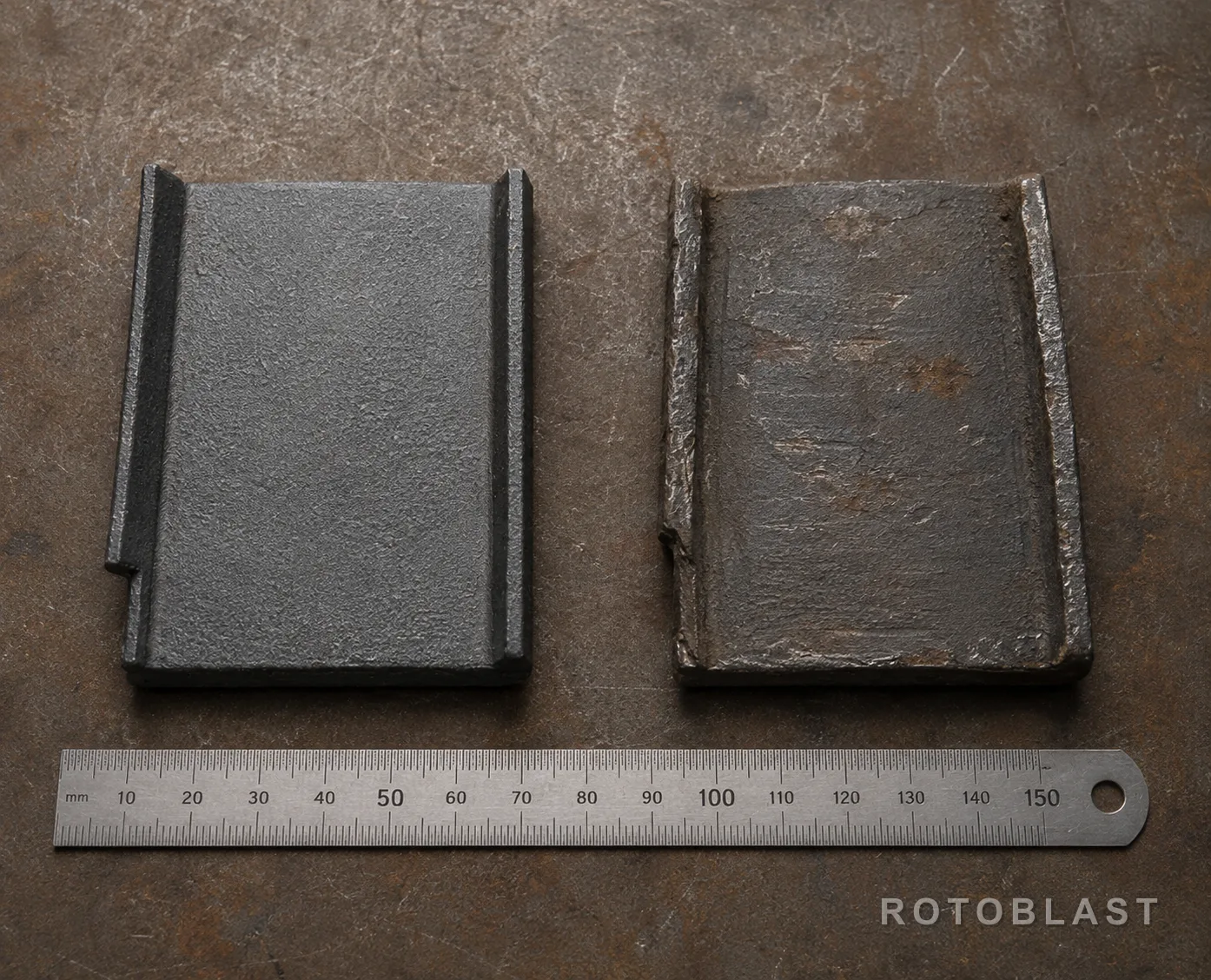
- 03A worn blade, photographed on both faces
- Shows the fixing type and how your machine is wearing.
- 04Number of blades per wheel
- Blades ship as a matched set, so the count matters.
Lead time
Indicative only. It depends on blade type, quantity and production scheduling. A confirmed schedule is given at order confirmation.
What support covers
- Identifying the blade from a photo
- Matched set sizing
- Fitting and balance guidance
- Wear inspection method
- Long-term technical assistance
Send us a worn blade, or a photo of one.
It tells us the machine, the fixing type and how your wheel is wearing. From that we can confirm the right Heavy Duty Blade and the correct set size for your wheel.
Request a quote
Tell us your application, part size and throughput — we'll respond with a specification and price.
Faridabad, Haryana, India
Mon–Sat, 9:30 AM – 6:30 PM IST