
CONTROL CAGE · BLAST WHEEL COMPONENTS
The window is not the exit.
A control cage has one opening. Most people assume that is where the abrasive comes out, so they point it at the part. It is not, and that mistake blasts the inside of your own machine.
The control cage is the part that decides where your blast stream lands. It does not spin and it does not throw anything. Set it wrong and it costs you far more than the part is worth.
Send us your cage dimensions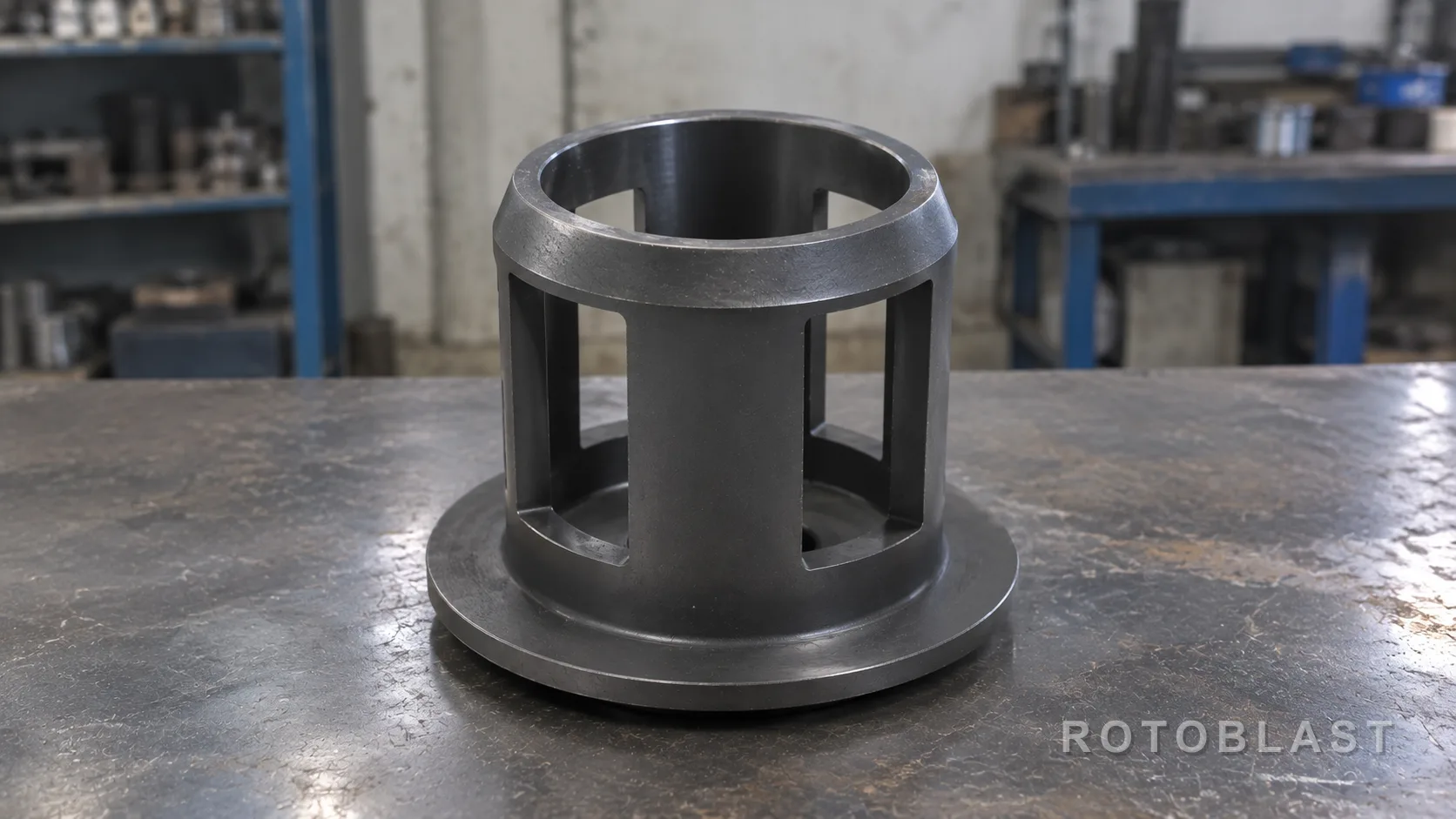
WHAT IT ACTUALLY IS
Everything in the wheel turns. This part does not.
Open a blast wheel and almost every part you see is moving. The impeller spins. The blades spin. The control cage sits between them and stays exactly where you bolted it. That is the whole idea.
In one paragraph
A shot blasting machine control cage is a fixed steel ring that sits inside the blast wheel, around the impeller. It has one opening. Abrasive can only reach the blades through that opening, so the cage does two jobs at once: abrasive flow control, and blast pattern control. You will hear it called a blast wheel control cage, a shot blast control cage, or just the cage — same part every time.
It holds the abrasive in
The impeller turns inside the cage and throws abrasive outward. The cage wall stops it. Shot cannot reach the blades anywhere except the one opening.
It times the loading
Each blade is only fed while it passes the window. Because the cage is fixed and the wheel turns, every blade gets loaded at the same point in every rotation.
It aims the stream
Move the window and you move where the abrasive starts its ride. Everything downstream moves with it. This is the only adjustment on a blast wheel that aims anything.
Why a stationary part still wears out
People expect the moving parts to wear and are surprised when the cage does. Abrasive is pressed against the inside of that wall by centrifugal force for every hour the machine runs. The wall does not have to move to be worn away.
THE 180 DEGREE RULE
Set the cage by the clock, not by eye.
Abrasive leaves the cage window, lands on a blade, and rides that blade for roughly half a turn before it lets go. So the stream leaves the wheel about 180 degrees away from the window. Engineers describe cage positions as clock hours for exactly this reason.
Set the cage opening
Click an hour to move the window. Watch where the stream goes.
Cage window at 12 o’clock · stream leaves near 6 o’clock
On the part. This is a working setting.
The mistake that destroys wheel housings
A maintenance fitter looks at the opening, decides that is where the shot comes out, and turns it to face the workpiece. The stream then leaves half a turn away and fires straight into the housing. The parts come out dirty, the housing wears through, and nobody connects the two for weeks.
If you have unexplained wear inside a wheel housing, check the cage setting before you order anything.
One or two degrees is not nothing
Wheel makers put the shift at roughly ten per cent of the pattern for a one to two degree error in the setting. That is why the cage is dowelled, marked or bolted to a fixed position rather than left to be judged by eye, and why the mark is worth restoring if it has been ground away.
WINDOW SIZE
Position aims the pattern. Size decides how hard it hits.
These are two separate settings and they get confused constantly. Turning the cage moves the pattern. Changing the size of the opening changes how long the pattern is, and a longer pattern spreads the same abrasive over more area.
Narrow opening
The abrasive is released over a smaller arc, so it lands in a tighter band. More impacts per square inch. Suits smaller parts and work where you want to cut fast in one place.
Wide opening
The release happens over a bigger arc, so the band is longer and thinner. Fewer impacts per square inch, but more coverage per pass. Suits wide work moving through on a conveyor.
Which one is right for your machine
This is not a free choice. The opening angle is matched to the wheel design and to the size of the work, and the machine builder set it for a reason. If your parts have changed since the machine was installed, that is worth a conversation before you change anything else.
HOW IT FAILS
A worn cage does not break. Its window grows.
Abrasive runs along the inside wall and escapes at the edges of the opening, so the edges are where the metal goes first. The window slowly gets bigger and its edges go from sharp to rounded. Nothing snaps. Nothing rattles. The setting you carefully made is quietly no longer the setting you have.
The edges round over
A sharp edge releases the abrasive at one clean point. A rounded edge lets it dribble out early and late.
Flow inside the wheel goes turbulent
Abrasive that should be pressed neatly against the wall starts tumbling. Feeding to the blades becomes uneven.
The pattern spreads and thins
The same amount of abrasive is now landing over a longer band, so the impacts per square inch drop.
Cycle time creeps up
Parts need longer to reach the same finish. Operators add time rather than report a fault, because nothing looks broken.
Other parts start paying
Abrasive landing where it should not lands on liners and housings. You buy those instead, and they cost more than a cage.
Check the impeller in the same visit
The impeller sits inside the cage and wears on the same abrasive. If its vanes are worn, feeding is already uneven before the shot ever reaches the window. Fitting a new cage behind a worn impeller buys you a few weeks, not a fix.
CHECK IT YOURSELF
Find the hot spot. It costs one painted plate.
You do not need instruments to know whether your cage is set right. You need a scrap plate, a can of paint and half a minute. This is the standard field check and it works on any wheel machine.
01
Paint a scrap plate
Any flat offcut, painted on one side, big enough to cover where you think the stream lands.
02
Run it about thirty seconds
Put it where your work normally sits and blast it. You want the paint stripped, not the plate cleaned all over.
03
Read the stripe, then feel it
The stripped band is your blast pattern. Touch it with the back of your hand. The centre of the pattern comes out hot, and that hot spot is where the wheel is really aimed.
04
Compare it to where the work is
If the hot spot sits off the plate, or off to one side of your parts, the wheel is not aimed at your work and cycle time is paying for it.
Do it once now, and keep the plate
Mark the date on the back and hang it by the machine. The next time cleaning goes slow, you have something to compare against instead of an argument about whether it used to be better.
How often
- Weekly, with the rest of your blast wheel maintenance.
- After any blast wheel component is changed.
- Any time cleaning quality or cycle time moves without an obvious cause.
REPLACEMENT
Fitting the cage is easy. Re-aiming it is the job.
Fitting a replacement control cage is not difficult work. What catches people out is that a rebuilt wheel does not automatically go back to the setting it had, and a machine that was cleaning fine on Friday can clean badly on Monday for that reason alone. Treat a blast wheel control cage replacement as a setting job with a parts change in the middle of it, not the other way round.
01
Mark the old position before anything moves
Scribe or paint a line across the cage and the housing while the old one is still bolted up. This is the only record of a setting that took someone real time to find.
02
Isolate and let the wheel stop
Power locked off and the wheel completely still. A blast wheel free-wheels for a long time after the motor is switched off.
03
Look at the impeller while it is open
With the cage out you can see the impeller properly. This is the only clear look you get, so take it before you close up.
04
Fit the new cage to the mark
Same orientation, same clock position, fully seated before anything is tightened.
05
Blast a test plate before production
Not after the first batch. Before it. Confirm the hot spot is where it was, and correct the setting now rather than explaining a rejected batch later.
06 · Before production
A rebuilt wheel can throw wrong from the first minute
If a wheel is stripped and reassembled without verifying the settings against the original set-up, it can be blasting the wrong place before it has run a single part. The wear that follows gets blamed on the new components. It was the setting.
SUPPLY & FITMENT
Cages are not common between makes.
A control cage for shot blasting machine wheels is matched to the wheel it sits in: the bore, the opening, the fixing and the overall width all have to be right, and every one of them differs between machine builders. We make to your wheel, not to a catalogue number.
01
Outside diameter and width
Measure the ring across its face and across its thickness. These two numbers narrow it down faster than a model number nobody can find.
02
The opening, measured at the wall
Measure the width of the window itself. If the old cage is worn, say so, because a worn window measures bigger than the one you actually need.
03
How it locates and fixes
Photograph the mounting face and any dowel, slot or bolt pattern. This is what decides whether a cage can hold its clock position.
04
The machine make, if you know it
Helpful, not essential. Plenty of machines on the floor have lost their paperwork and we work from the part every day.
Rotoblast is a control cage manufacturer in India, not a reseller. We make them at our own works in Faridabad alongside the rest of our blast wheel spare parts and industrial shot blasting components, and we supply them to foundries, fabricators and machine owners across India and the UAE. If you are looking for a control cage supplier in UAE, the part is made here and shipped to you. Where a cage is non-standard or the wheel is an imported make, we work from your sample.
Lead time
Depends on cage size, quantity and production scheduling. A confirmed date is given at order confirmation.
What we help with beyond the part
- Identifying the cage from photographs and measurements
- Matching the opening to the work you are running now
- Setting guidance and the hot-spot check
- The rest of your shot blasting spare parts, quoted as one set
ASKED ON THE FLOOR
The questions we get before a cage is ordered.
NEXT STEP
Measure the window. We will make the cage.
Three measurements and one photograph of the mounting face are enough for us to confirm the right control cage for your wheel. If measuring is awkward with the machine in production, post us the worn cage and we will work from it.
Read next
- Blast wheel assembliesWhere the cage sits, and the parts either side of it.
- Blast wheel bladesWhat the abrasive rides on after it leaves the window.
- Wheel hubCarries the blades the cage aims at. Worn seats move the whole pattern.
- Steel shotAbrasive size and cleanliness decide how fast the window wears.
Rotoblast manufactures this part alongside the rest of the wear items a shot blasting machine consumes. See the full spare parts range
Request a quote
Tell us your application, part size and throughput — we'll respond with a specification and price.
Faridabad, Haryana, India
Mon–Sat, 9:30 AM – 6:30 PM IST