SIDE LINER · BLAST WHEEL HOUSING
They do not just protect. They contain.
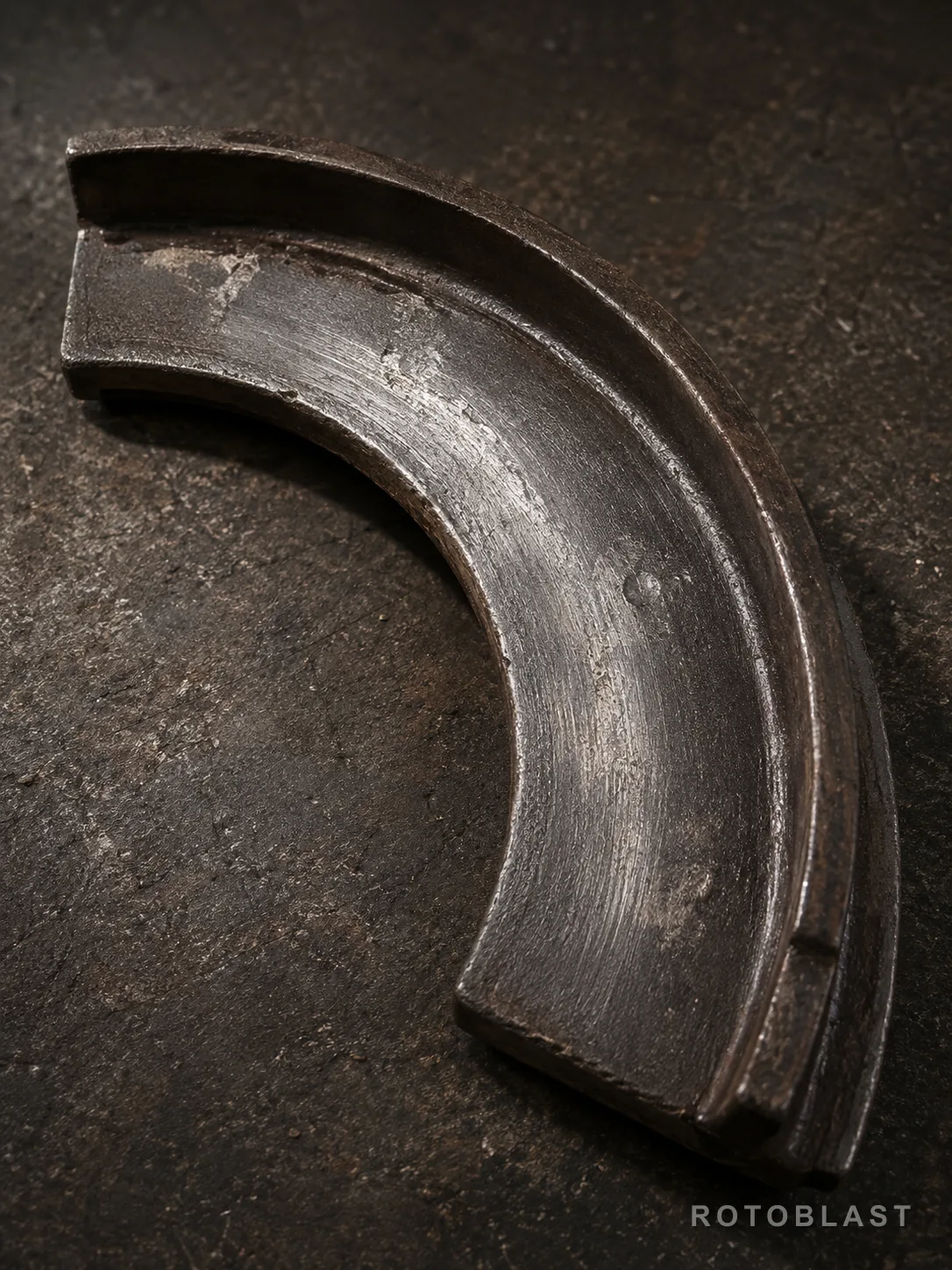
Side liners sit either side of the blast wheel, inside its housing. They keep the abrasive in the stream while the wheel throws it. When they wear, the abrasive starts going sideways instead.
WHERE THEY SIT
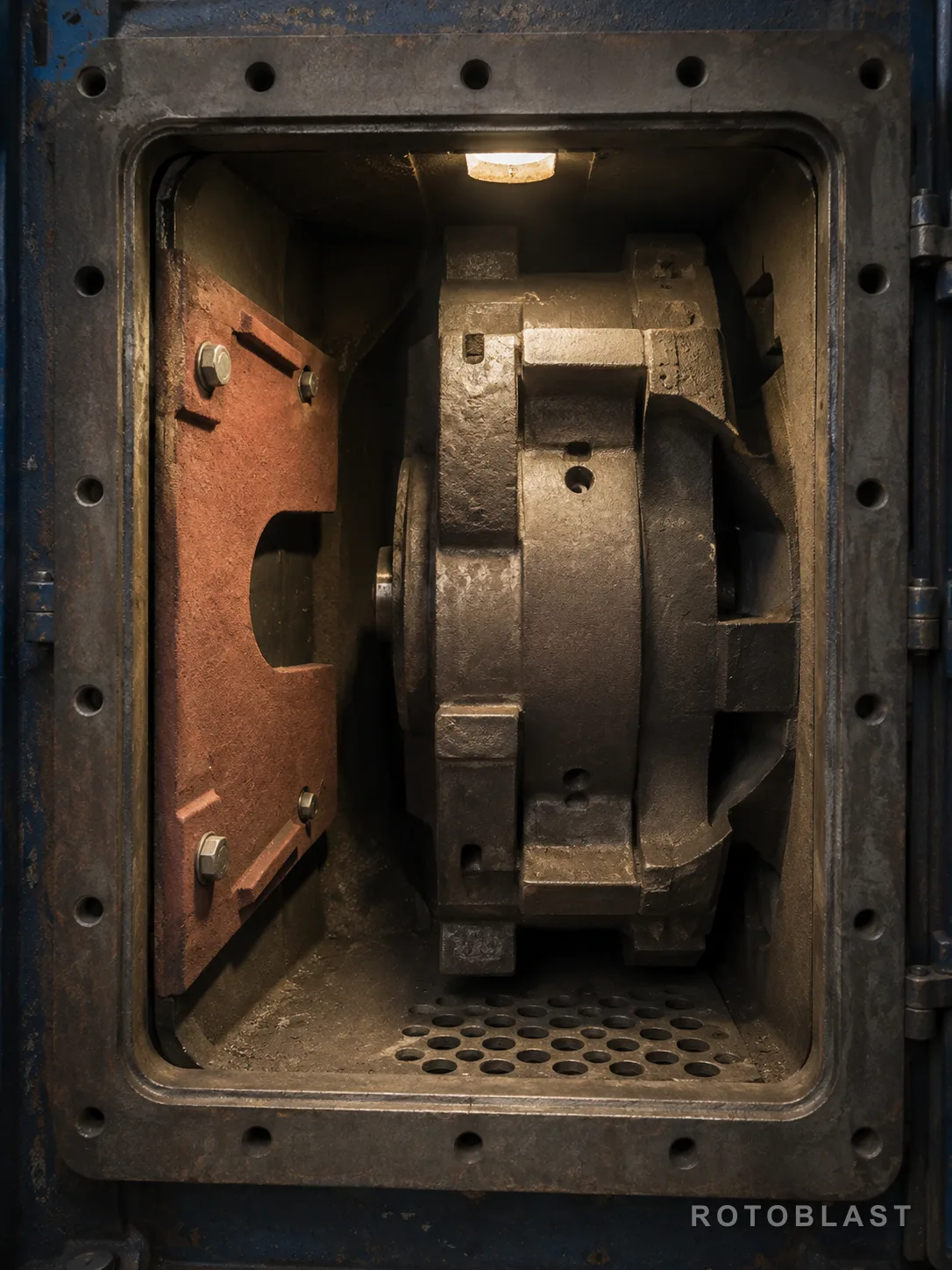
Inside the wheel housing, not in the cabinet.
This is the part most people have never seen. It is bolted inside the blast wheel housing, one on each side of the wheel. You cannot see it with the machine closed, and you cannot see it from inside the cabinet either.
01 · Housing
The steel box the wheel runs inside. It is structure, and it is not a wear part.
02 · Side liners
Bolted to the inside faces, one each side. They take everything the housing would have taken.
03 · The wheel
Spins between them. The blades pass close to the liner faces, by design.
04 · The stream
Abrasive stays between the two liners until it leaves through the opening.
What they are standing in front of
- The housing side walls
- Structure. If these go, you are welding, not bolting.
- The wheel mounting faces
- Where the wheel is located and held true.
- The bearing housing area
- Abrasive reaching bearing seals is how bearings die early.
THE PART NOBODY EXPLAINS
A worn side liner leaks your blast.
There is a set gap between the blade tips and the liner face. That gap is small on purpose. It keeps the abrasive travelling with the blade instead of slipping past the side of it.
Correct gap
Abrasive stays with the blade all the way out. Full energy reaches the part.
Correct gap: Abrasive stays with the blade all the way out. Full energy reaches the part.
The gap is drawn large enough to see. It is not a measurement, and the correct running clearance belongs to your wheel manufacturer. Compare your own two sides against each other rather than against a number from a web page.
You pay for this twice
First in electricity, because the motor is still working to throw abrasive that goes nowhere useful. Then in cycle time, because the part needs longer under the blast to reach the same finish. Both start slowly and neither shows up as a breakdown.
The signal to watch for
Cleaning slows down and nobody can explain it. The wheel sounds normal. The blades look serviceable. The abrasive is fine. When everything checks out and the cycle is still creeping up, open the housing and look at the side liners.
WHEN TO INSPECT
You only see them when the housing is open.
Nobody opens a wheel housing just to look at a liner. It comes apart when the blades are changed. So side liners get inspected on the blade schedule, whether or not anyone plans it that way.
- 01
Check them every time the housing is open
It costs a few minutes while you are already in there. Skipping it means waiting until the next blade change to find out.
- 02
Look at the gap, not just the plate
The plate can still look solid while the running clearance has opened up. It is the gap between blade tip and liner face that tells you the truth.
- 03
Compare the two sides against each other
They should wear at a similar rate. If one is clearly worse, something is feeding or aiming off centre, and the liner is a symptom rather than the fault.
- 04
Decide before you close it up
If the set will not comfortably last until the next blade change, change it now. Opening a housing twice costs far more than the plate does.
Change them as a pair
The two sides work together to hold the abrasive between them. Fitting one new liner against a worn one leaves the stream contained on one side and leaking on the other. You paid for a new plate and kept the problem.
SUPPLY & FITMENT
Send the wheel, not the liner.
Side liners are cut to the housing they sit in. The same machine model can carry different wheels, and the wheel decides the plate. Telling us the wheel gets you the right part first time.
- 01Blast wheel make and size
- The wheel sets the liner shape and the fixing centres.
- 02Machine make and model
- Confirms the housing the wheel is mounted in.
- 03A photo of the housing with the liner in place
- Shows the fixing type and how the plate is located.
- 04Whether you are replacing one wheel or several
- Liners go as pairs, so the count follows the wheels.
Made at our works in Faridabad, India, and supplied to foundries, fabrication companies and machine owners in India and across the UAE.
Lead time
Indicative only. It depends on wheel type, quantity and production scheduling. A confirmed schedule is given at order confirmation.
What support covers
- Identifying the liner from the wheel
- Running clearance guidance
- Fitting and pairing advice
- Inspection routine for your blade schedule
- Long-term technical assistance
Book them in with your next blade change.
The housing is already coming apart. Have the liners on the shelf before it does, and one stoppage does both jobs instead of two.
Rotoblast manufactures this part alongside the rest of the wear items a shot blasting machine consumes. Browse shot blasting machine spare parts
Request a quote
Tell us your application, part size and throughput — we'll respond with a specification and price.
Faridabad, Haryana, India
Mon–Sat, 9:30 AM – 6:30 PM IST