
Industries · Railway
Shot Blasting Solutions for Railway Component Manufacturers
Improve rust removal, weld cleaning, mill scale removal, and paint adhesion for railway components with shot blasting solutions engineered for railway equipment manufacturers, wagon builders, coach manufacturers, fabrication companies, and railway suppliers across India and the UAE.
- Wagon & Coach Builders
- Railway Fabrication
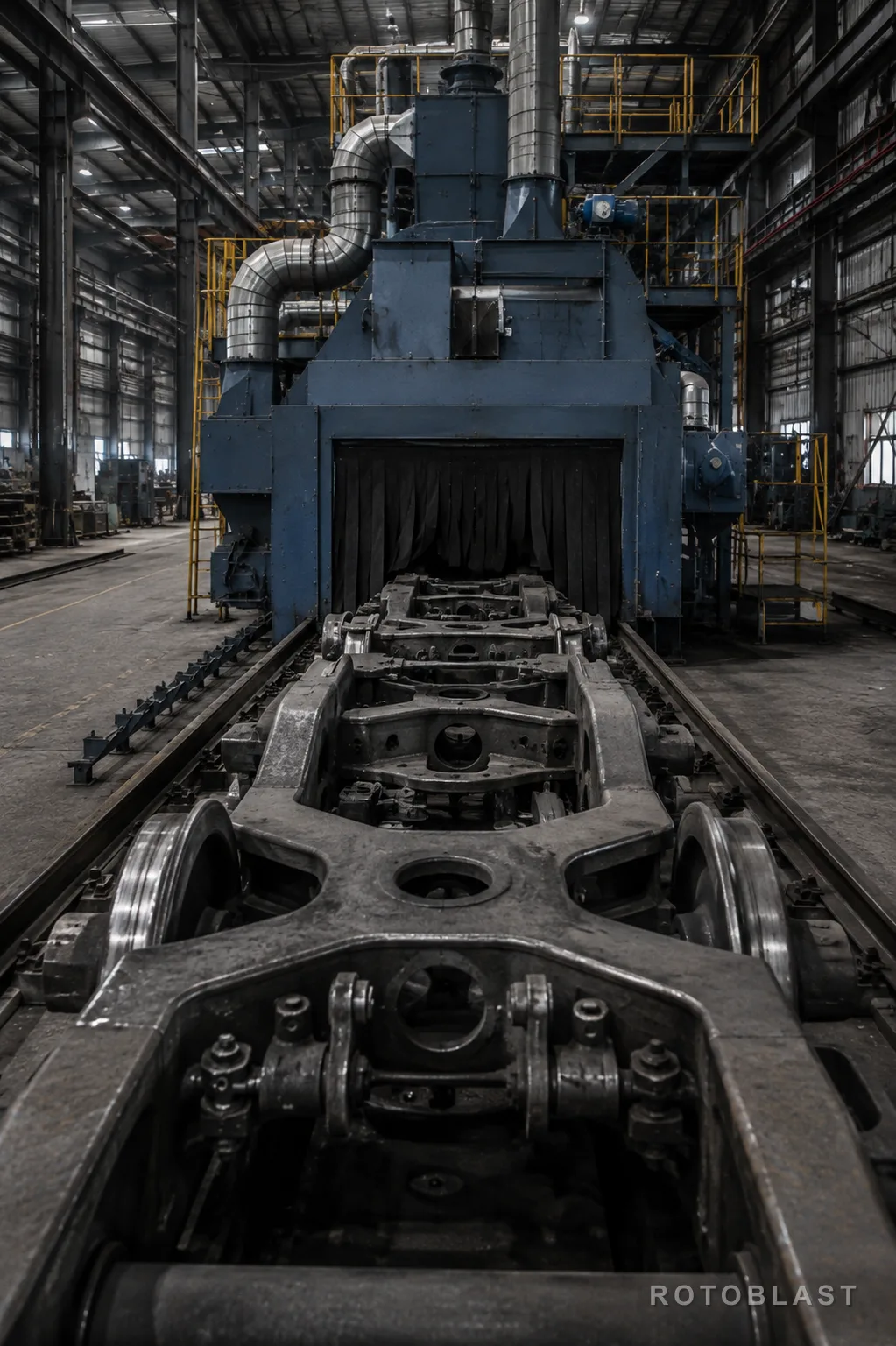
Common Surface Preparation Challenges in Railway Component Manufacturing
From bogies to coach structures, these are the surface problems that slow railway fabrication down most.
Rust Before Painting Railway Components
Flash rust on cleaned parts before coating causes rejections and rework.
Mill Scale on Fabricated Railway Structures
Tight oxide scale on fabricated sections resists coating and hides defects.
Weld Slag on Heavy Fabricated Assemblies
Slag and spatter around welds break coating films and mar the finish.
Poor Paint Adhesion on Railway Parts
Without a clean anchor profile, coatings blister and peel in service.
Inconsistent Surface Finish Before Coating
Uneven cleaning across batches affects coating quality and appearance.
High Cleaning Costs & Production Downtime
Manual cleaning inflates cost and interrupts production schedules.
Recommended Surface Preparation Solutions for Railway Manufacturers
Machines, engineering support and genuine parts — matched to your railway components and production volume.
- 01Shot Blasting MachinesRemove rust, mill scale, welding slag, and surface contamination from railway components before coating, assembly, and dispatch.Explore Machines
- 02Engineering ServicesPreventive maintenance, emergency breakdown support, installation, commissioning, and machine overhauling.Explore Services
- 03OEM Spare PartsOEM blast wheel blades, control cages, impellers, liners, separators, and wear parts for reliable production.View Spare Parts
Components Commonly Processed
Components Commonly Processed
Rolling stock reaches surface preparation as large welded steel assemblies. These are the ones that come through in volume.
- 01
Bogie Frames
Surface as receivedWeld scale, spatter and mill scale over a fabricated steel frame
Why it is blastedCoating over weld scale fails first at the weld toe, where fatigue loading is highest
Next operationPrimer, then the finish system
- 02
Underframes & Chassis Structures
Surface as receivedMill scale on rolled sections, plus rust from outdoor storage between stages
Why it is blastedLong structures sit in the yard between fabrication and paint and flash-rust
Next operationPrimer within the shop's overcoat window
- 03
Wagon Body Panels & Side Walls
Surface as receivedMill scale on plate, weld spatter along stiffener seams
Why it is blastedLarge flat areas show every coating defect, and wagons live outdoors for decades
Next operationZinc-rich primer or a full protective system
- 04
Couplers & Draft Gear Components
Surface as receivedAs-cast surface with foundry sand and scale
Why it is blastedCastings need cleaning before inspection can find surface defects at all
Next operationMagnetic particle inspection, then machining
- 05
Brake & Suspension Components
Surface as receivedCast and forged surfaces carrying scale from heat treatment
Why it is blastedScale hides cracks and prevents a uniform coating on safety-critical parts
Next operationInspection, machining and assembly
Wheelsets and axles are machined and gauge-critical. Where they are processed at all it is a controlled, masked operation — not general blasting.
Surface Specification
What the Coating System Demands
A rail vehicle is coated once and then stands outdoors for decades. The specification names a blast grade from ISO 8501-1, and the assembly has to reach that grade and get primed inside the overcoat window — the time the paint data sheet allows between blasting and primer. Below is what each grade means in practice.
- 01Bare steelArrives with mill scale, rust and old coating on it.
- 02Shot blastingStrips all of that off and cuts a controlled roughness into the metal.
- 03PrimerFlows into that roughness and locks on. Smooth steel gives it nothing to hold.
- 04Top coatsThe corrosion barrier. It only lasts as long as the primer underneath holds.
Blasting is not just cleaning. It is what gives the paint something to hold on to.
Zinc-rich and high-build systems used on rolling stock generally require the higher grades. Confirm against your own coating specification.
Required
Sa 2½ · Very thorough blast-cleaning
In simple termsClean grey steel with only faint shadows left. This is the condition zinc-rich primer needs to bond properly.
Only faint shadows or staining remain. Standard requirement before zinc-rich primer on fabricated rail assemblies.
- Anchor profile
- 40–75 µmHeight from valley to peak that the blast leaves. This is the grip.
- Profile grade
- ISO 8503 medium (G)The ISO 8503 comparator plate an inspector checks that roughness against.
- Abrasive
- Angular steel grit, or shot/grit mixWhat produces it — round shot cleans, angular grit cuts a sharper profile.
- Specified for
- Bogie frames, underframes and body panels before the protective system.Where this grade is normally called up.
What to check before primer
- 01Blast and prime in the same shift. Bare steel left overnight flash-rusts, and the grade you paid for is gone.
- 02Check the roughness with an ISO 8503 comparator before primer goes on, not after.
- 03Inspect box sections, weld seams and the underframe. Those are the last places the abrasive reaches and the first places the coating fails.
If the surface is not right
Prime over scale or flash rust and the zinc-rich coat never reaches the steel, so it cannot protect it. The failure shows at the seams and underframe first — exactly where a repaint means taking the vehicle out of service.
Why Railway Manufacturers Choose Rotoblast
- Railway Industry Expertise
- Solutions built around railway components and rolling stock.
- Surface Preparation for Heavy Components
- Capacity and profile control for large, heavy assemblies.
- OEM-Quality Spare Parts
- Wear parts engineered for long, dependable service life.
- Experienced Service Engineers
- Specialists who diagnose root causes, not symptoms.
- Support Across India & UAE
- Responsive engineering support wherever you produce.
Engineering Knowledge Centre
Practical answers to the surface preparation questions railway manufacturers ask most.
Need application advice?
Talk to an EngineerPlan the Installation
Need the Right Shot Blasting Solution for Your Railway Manufacturing Facility?
Tell us about your railway components, production volume, coating requirements, and surface preparation challenges. Our engineers will recommend the most suitable shot blasting machine, engineering service, or OEM spare parts for your manufacturing process.
What we need to answer
- 01
- The assemblyLargest bogie frame, underframe or body panel you need to handle.
- 02
- Production volumeAssemblies per shift, and whether the shop runs mixed types.
- 03
- Coating specificationThe protective system and the overcoat window you work to.
Send these three and you get a specification back, not a brochure.
Request a quote
Tell us your application, part size and throughput — we'll respond with a specification and price.
Faridabad, Haryana, India
Mon–Sat, 9:30 AM – 6:30 PM IST